

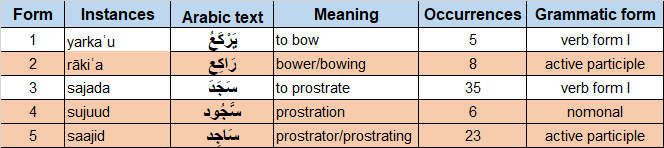
Note: The table is populated with data obtained from the Quran.corpus.com, and `a denotes the Arabic letter ayn.
Out of 13 instances of yarka`u and its derived forms, 5 instances of yarka`u meaning ‘to bow’ in the verb 1 form have been reviewed, 8 instances raaki`a meaning ‘bower/bowing’ in active participle form in the Quran, while out of 64 instances of sajada and its derived forms, 35 instances of sajada meaning ‘to prostrate’ in the verb form I in the Quran have been reviewed, 6 instances of sujuud meaning ‘prostration’ in the nominal form and 23 instances of saajid meaning ‘prostrator/prostrating’ in the active participle form, which are reviewed below to better understand their meanings in different contexts:
Instances of raaki`a
There are 8 instances of raaki`a in the active participle form meaning bower/bowing in 8 verses of 7 surahs in the Quran are detailed below to better understand their meanings in different contexts:
[2:43] And you shall establish the salat prayer and shall give the zakat and shall bow down with those who bow down (ma`a al-raaki`eena).
[2:125] And when we had made the House a place of return for the people and a security; and you shall take a standing place of Abraham as a place of prayer. And we had made a covenant with Abraham and Ismail that you shall purify My House for those who circumambulate, and those who devote themselves, and those who bow (wal-ruka`i) and those who prostrate.
[3:43] “O Mary, you shall be obedient to your Lord, and shall prostrate and bow down with those who bow down (ma`a al-raaki`eena).”
[5:55] Your (the believers) only ally is God and His messenger, and those who have believed, and those who establish the salat prayer and give the zakat, and they are those who bow down (wa-hum raaki`uuna).
[9:112] The repenters, the worshipers, the praisers, the wanderers, the bowers (al-raaki`uuna), the prostrators, the advocators of the right and the forbidders from the wrong, and the protectors of limits of God, and you shall give a good news to the believers.
[22:26] And when we had assigned a site of the House to Abraham that you shall not associate anything with Me and shall purify My House for those who circumambulate, and those who stand, and the bowers, the prostrators (wal-ruka`i al-sujuudi).
[38:24] He (David) said, “He (who owned 99 sheep) has wronged you (who owned one sheep) by demanding your ewe to his ewes. And indeed, many of the partners surely oppress of them over other except those who have believed and have done the righteous deeds, and they are a few.” And David had become certain that we tested him, so he had asked forgiveness of his Lord and had knelt down in bowing (raaki`an) and had turned in repentance.
[48:29] Muhammad, a messenger of God and those who are with himself are harsh against the disbelievers, while are merciful between themselves. You see them as bowers prostrators (rukka`an sujjadan) and prostrators seeking blessing from God and pleasure. Their mark is on their faces from a trace of the prostration. That is their analogy in the Torah, while their analogy in the Gospel is like a seed has produced its shoot, then it has strengthened it, then it has become thick, then it has stood upon its stem to please the sowers that He can enrage the disbelievers by them. God has promised those who have believed and have done the righteous deeds of them forgiveness and a great recompense.
Instances of sujuud
There are 6 instances of sujuud in the noun and adjective of the nominal form meaning prostration/prostrator, which are detailed below to understand their meaning in different contexts:
Nominal form
Noun
[48:29] Muhammad, a messenger of God and those who are with himself are harsh against the disbelievers, while are merciful between themselves. You see them as bowers and prostrators seeking blessing from God and pleasure. Their mark is on their faces from a trace of the prostrations (min athari al-sujuudi). That is their analogy in the Torah, while their analogy in the Gospel is like a seed has produced its shoot, then it has strengthened it, then it has become thick, then it has stood upon its stem to please the sowers that He can enrage the disbelievers by them. God has promised those who have believed and have done the righteous deeds of them forgiveness and a great recompense.
[50:40] And of the night that you shall glorify Him, and after the prostrations (wa-abbaara al-sujuudi).
[68:42] A day there will be uncovered from shin, and they will be called to the prostrations (ilaa al-sujuudi), but they cannot be able.
[68:43] They are humbled, their eyes will cover them with humiliation. And indeed, they had been to be called to the prostration (ilaa al-sujuudi), while they were sound.
Adjective
[2:125] And when we had made the House a place of return for the mankind and a security; and you shall take a standing place of Abraham as a place of prayer. And we had made a covenant with Abraham and Ismail that you shall purify My House for those who circumambulate, and those who devote themselves, and the bowers, the prostrators (wal-nuka`i al-sujuudi).
[22:26] And when we had assigned a site of the House to Abraham that you shall not associate anything with Me and shall purify My House for those who circumambulate, and those who stand, and the bowers, the prostrators (wal-ruka`i al-sujuudi).
Instances of saajid
There are 23 instances of saajid in the noun and adjective of the active participle form meaning prostrator/prostrating, which are detailed below to understand their meaning in different contexts:
Active participle
Noun
There 17 instances of saajid in the noun form in 17 verses of 12 surahs, which are described below:
[2:58] And when we said, “Enter this – the town, then shall eat from it as much wherever you have wished and enter the gate as prostrators (wa-ud’khuluu al-baaba sujjadan) and say, “Repentance.” We will forgive your sins for you and will increase (your reward) as the good doers”
[4:154] And we had raised the mount above of them on their covenant, while we said to them, “Enter the gate as prostrators (ud’khuluu al-baaba sujjadan),” and we said to them not to transgress in the Sabbath. And we had taken from them a solemn covenant.
[7:11] And that certainly, we have created you, then we have shaped you, then we said to the angels, “Prostrate to Adam.” They had prostrated except Iblis; he was not with the prostrators (lam yakun mina al-saajideena).
[7:120] And it has been fallen down the magicians as prostrators (wa-ul’qiya al-saharatu saajideena).
[7:161] When it had been said to them (the people of Moses), “You shall enter this – the city and shall eat from it wherever you have wished, and shall say, “Repentance,” and shall enter the gate as prostrators (wa-ud’khuluu al-baaba sujjadan). We will forgive your sins for you. We will increase (reward) of the good-doers.”
[9:112] The repenters, the worshipers, the praisers, the wanderers, the bowers, the prostrators (al-saajiduuna), the advocators of the right and the forbidders from the wrong, and the protectors of limits of God, and you shall give a good news to the believers.
[12:4] When Yusuf said to his father, “O my father, indeed me, I have seen eleven stars, and the sun, and the moon; I have seen them as prostrators to me (raa-aytuhum li-i saajideena).”
[15:29] Then when I have designed him and have breathed into him from My spirit, then you shall fall down to him as prostrators (fa-qa`uu lahu saajideena).”
[15:31] except Iblis. He had refused to be with the prostrators (abaa an yakuuna ma`a al-saajideena).
[15:32] He said, “O Iblis, what is for you that you would not be with the prostrators (yaa’ib’leesu maa laka allaa takuuna ma`a al-saajideena)?”
[15:98] So, you shall glorify with praise of your Lord, and shall be with the prostrators (wa-kun mina al-saajideena).
[19:58] Those are the ones whom God has bestowed favor upon them of the prophets from descendants of Adam, and of whoever we had carried with Noah, and from descendants of Abraham and Israel, and of whoever we had guided and had chosen. When was recited to them revelations of the Gracious, they had fallen as prostrators and in weeping (kharruu sujjadan wa-bukiyyan).
[26:46] Then there had been fallen down the magicians as prostrators (fa-ul’qiya al-saharatu saajideena).
[26:219] And your movements among the prostrators (wa-taqallubaka fee saajideena).
[32:15] Only believe in our revelations those when they have been reminded with them have fallen down as prostrators (idhaa dhukkiruu bihaa kharruu sujjadan), and they have glorified with praise of their Lord, and they do not be arrogant.
[38:72] So, when I have designed him and have blown into him from My spirit, then you shall fall down to him as prostrators (fa-qa`u lahu saajideena).”
[39:9] Is he whoever a devotee to hours of the night prostrating and standing in fearing the Hereafter (aanaa-a al-layli saajidan wa-qaaiman yahdharu al-aakhirata) and expecting a mercy of his Lord? Say, “Are those who know and those who do not know equal?” Only possessors of the understanding will take heed.
Adjective
There are 5 instances of saajid in the adjective form in 5 verses of 5 surahs, which are described below:
[16:48] Do they not look at what God has created from a thing? There inclines its shadows to the right and the left prostrating to God (yatafayya-u zillaluhu `ani al-yameeni wa-al-shamaa-ili sujjadan lillahi), while they are humble.
[17:107] Say: “Believe in it or do not believe. Indeed, those who have been given the knowledge from before of it, when it is recited to them, they fall on their faces in prostration (yakhirruuna lil’adhqaani sujjadan).”
[20:70] So, the magicians had been thrown down as prostrators (fa-ul’qiya al-saharatu sujjadan). They said, “We have believed in Lord of Aaron and Moses.”
[25:64] And those who spend night prostrating for their Lord (wa-alladheena yabeetuuna li’rabbihim sujjadan) and standing.
[48:29] Muhammad, a messenger of God and those who are with himself are harsh against the disbelievers, while are merciful between themselves. You see them as bowers, prostrators (rukka`an sujjadan) seeking blessing from God and pleasure. Their mark is on their faces from a trace of the prostration. That is their analogy in the Torah, while their analogy in the Gospel is like a seed has produced its shoot, then it has strengthened it, then it has become thick, then it has stood upon its stem to please the sowers that He can enrage the disbelievers by them. God has promised those who have believed and have done the righteous deeds of them forgiveness and a great recompense.
Upon review of the messages of the above instances of raaki`a meaning ‘bowing/bower’ we may reflect that bowing is not only a step of performing the salat prayer but also to be obedient to God, while He wants us to be allies of Him and His messenger to be with those who bow.
Upon review of the messages of the above instances of sujuud meaning ‘prostration/prostrator’ we may reflect that we may glorify our Lord after prostration at the night for His blessing and pleasure, and there will be mark on the foreheads for their prostrations, while on a day many of us will be called for prostration but they cannot make it.
Upon review of the messages of the above instances of saajid meaning ‘prostrator/prostrating’ we may reflect that among the angels except Iblis were not among the prostrators to Adam. Those whom God has favored are the prophets, whomever He has guided, whomever He has chosen – they have fallen as protectors when His revelations were recited to them, and also of those who are devotee of their Lord for expecting mercy of their Lord.
However, we may be obedient to God for His blessing and pleasure as prostrators like that what He has created, its shadows are prostrating to Him, expecting His mercy on a day of our meeting to Him.
Peaceful Friday, salaam and God bless.
Tafazzal (11/07/2025).