

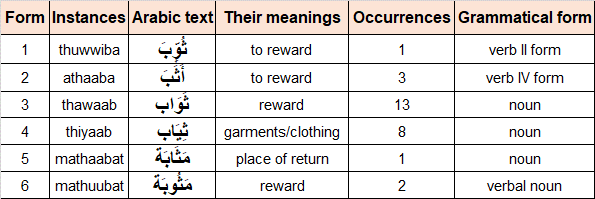
Note: The above table is populated with the data obtained from the corpus.quran.com.
Instance of thuwwiba
There is one instance of thuwwiba in the verb II form meaning ‘to reward’ found in one verse of the Quran, which is described below:
[83:36] Have the disbelievers been rewarded (hal thuwwiba al-kufaaru) for whatever they had done to accomplish?
Instances of athaaba
There are 3 instances of athaaba in the verb IV form meaning ‘to reward’ found in 3 verses of 3 surahs in th Quran, which are described below to better understand their meaning:
[3:153] When you were running uphill, while you were not looking towards anyone, and the messenger called you from behind of you. So, He had given you distress over distress (fa-athaabakum ghamman bi-ghammin) that you do not grieve over what had escaped you, and what had not befallen you. And God is Cognizant of what you do.
[5:85] So, God has rewarded them for what they said (fa-athaabahumu allahu bimaa qaaluu), gardens from underneath of them the rivers will flow, as dwellers therein forever. And that is a recompense for the good-doers.
Note: Here is a reference from the previous verses that those who had believed in the Quran among the Christians while they said why they do not believe when the truth has come and their Lord will admit them with the righteous people.
[48:18] That certainly, God has been pleased with the believers when they pledge allegiance to you (prophet) under the tree. That He had known what is in their hearts, so, He has sent down the tranquility upon them, and has rewarded them a near victory (fa-athaabahum fathan qareeban).
Instances of thawaab
There are 13 instances of thawaab in the noun form meaning ‘reward’ found in 9 verses of 5 surahs in the Quran, are described below to better understand their meaning in different contexts:
[3:145] And it has not been for any soul (person) that it dies except by permission of God, is a determined decree. And whoever desires a reward of the world (wa-man yurid thawaaba al-dun’yaa), we give him from it, and whoever desires a reward of the Hereafter (wa-man yurid thawaaba al-aakhirati), we give him from it. And we will recompense the grateful ones.
[3:148] So, God has given them a reward in the world (fa-aataahumu allahu thawaaba al-dun’yaa), while there is a better reward in the Hereafter (wa-hus’ana thawaabi al-aakhirati). And God loves the good-doers.
Note: Here is a reference from the previous verse that those who have prayed to their Lord to forgive them for their sins and their transgression in their affairs as well as to make firm their feet and to give them victory over the disbelieving people, for them is a reward in the world, while there is a better reward in the Hereafter.
[3:195] Then their Lord has responded to them: “Indeed Me, I do not let go waste deed of a doer among you from a male or a female, each of you is for the other. So, those who have immigrated, and have been driven out from their homes, and have been harmed in My path, and have fought and have been killed; that I will surely remove their evil deeds from them, and that I will surely admit them to gardens from underneath of them the rivers flow, a reward on behalf of God (thawaaban min `indi allahi), and God, with Him is the best reward (wa-allahu `indahu hus’nu al-thawaabi).”
[4:134] Whoever has done to desire a reward of the world (man kaana yureedu thawaaba al-dun’yaa), then with God is a reward of the world as well as of the Hereafter (fa-`inda allahi thawaabu al-dun’yaa wal-aakhirati). And God has been Hearer, Seer.
[18:31] Those, for them are gardens of Eden from underneath of them the rivers will flow; they will be adorned therein with bracelets of gold and will wear green garments of fine silk and heavy brocade, reclining therein on the adorned couches. It has been excellent is the reward (ni`ma al-thawaabu) and has been good is a place of resting.
Note: Here is a reference from the previous verse for those who have believed and have done the righteous deeds that God does not fail to give them such reward.
[18:44] There is the protection of God, the Truth. He is best for a reward (huwa khayrun thawaaban) and best for an end.
[18:46] The wealth and the children are adornment of the life of the world, but the enduring righteous deeds are better for a reward from your Lord (wal-baaqiyaatu al-saalihaatu khayrun `inda rabbika thawaaban) and better for a hope.
[19:76] And God increases guidance of those who have accepted guidance, while the enduring righteous deeds are better for a reward from your Lord (wal-baaqiyaatu al-saalihaatu khayran `inda rabbika thawaaban) and are better for return.
[28:80] And those who have been given the knowledge said, “Woe to you, a reward of God is better for whoever has believed and has done as a righteous one (thawaabu allahi khayrun liman aamana wa-`amila saalihan).” And it is not granted except for the patient.
Instances of thiyaab
There are 8 instances of thiyaab in the noun form meaning ‘garments/clothing’ found in 8 verses of 7 surahs in the Quran are described below to better understand their meaning, while we know that an Arabic word may have different meaning in different contexts:
[11:5] No doubt, they fold their breasts that they may hide from Him. No doubt, when they cover with their clothes (a-laa heena yas’tagh’shuuna thiyaabahum), He knows what they conceal and what they reveal. Indeed, He is Knower of what is in the breasts.
[18:31] Those, for them are gardens of Eden from underneath of them the rivers will flow; they will be adorned therein with bracelets of gold and will wear green garments of fine silk and heavy brocade (wa-yal’basuuna thiyaaban khud’ran min sundusin wa-is’tab’raqin), will be reclining therein on the adorned couches. It has been excellent is the reward and has been good is a place of resting.
Note: Here is a reference from the previous verse for those who have believed and have done the righteous deeds that God does not fail to give them such reward.
[22:19] These two parties (the believers and the disbelievers) have disputed about their Lord. Then those who have disbelieved has been cut out garments of fire for them (fa-alladheena kafaruu qutti`at lahum thiyaabun min naarin). The boiling water will be poured over their heads.
[24:58] O you who have believed; let ask you permission of those whom has been rightfully yours (attendants) and those who do not reach the puberty at three times – before the Dawn Prayer, and when you put aside your garments during the noon time (for rest) (wa-heena tada`uuna thiyaabakum mina al-zaheerati), and after the Night Prayer, are three private times for you. It has not been upon you, nor upon them any blame after of them mingling among you, each of you is with the other. Thus that God makes clear the revelations for you, and God is Knower, Wise.
[24:60] And the post-menopausal among the women who do not desire for marriage, then it has not been upon them any blame that they put aside their garments without displaying of their beauty (an yada`na thiyaabahunna ghayra mutabarrijaatin bi-zeenatin). And that they may be modest is better for them. And God is Hearer, Knower.
[71:7] And indeed me (Noah), every time I have invited them that You may forgive for them, they have put their fingers in their ears, and have covered them with their garments (wa-is’tagh’shaw thiyaabahum), and have been persistent and arrogant with arrogance.”
[74:4] And your garments that you shall purify (wa-thiyaabaka fa-tah’hir).
Note: Here is an order of God for the messenger He has promised to come (3:81, 33:7) to remove what is extraneous in the Quran as well as in our beliefs and practices in order to purify. Thus, garments is an allegorical representation referring to our guidance, beliefs and practices that makes sense in the context, which many of us may not reflect.
[76:21] Covering of them will be garments of fine green silk and heavy brocade (`aaliyahum thiyaabu sundusin khud’run wa-is’tab’raqun). And they have been adorned with bracelets of silver and their Lord has given them to drink a pure drink.
Note: Here is a reference of a reward for the righteous who fulfill their vows to God and feed the poor, the orphan and the captive with love for His pleasure, and fear a miserable and distressful day of their Lord.
Instance of mathaabat
There is one instance of mathaabat in the noun form meaning ‘a place of return’ found in one verse of the Quran, which is detailed out below:
[2:125] And when we had made the House a place of return for the mankind and a security (wa-idh ja`alnaa al-bayta mathaabatan lil’nnasi amman); and you shall take a standing place of Abraham as a place of prayer. And we had made a covenant with Abraham and Ismail that you shall purify My House for the circumambulators, and the devotees, and the bowers, the prostrators.
Instances of mathuubat
There are 2 instances of mathuubat in the verbal noun form meaning ‘reward’ found in 2 verses of 2 surahs in the Quran are detailed out below:
[2:103] And if that they had believed and had feared (God), that a reward from God would be better (la’mathuubatun min `indi allahi khayrun) if they had done to know (it)
[5:60] Say, “Shall I inform you of worse than that a recompense from God (hal unaabbi-ukum bi-sharrin min dhaalika mathuubatun `inda allahi? Whomever God has cursed, and He has been angry upon them and has made from them the apes and the pigs, and whoever has worshiped the false deities. Those are worse in position and faraway astray from an evenness of the path (of God).”
Upon review of 28 instances of thuwwiba and its kinds in different grammatical forms found in 23 verses of the Quran reflecting to both literal and allegorical meaning of thiyaab, while the Ka’bah is a place of return for mankind and a security that they may remember God in it being it a ritual for them, we may understand that the righteous will be rewarded for what they have done to achieve and the disbelievers will be rewarded for what they have done to achieve as well, while God rewards them in the world as well as in the Hereafter, and He is the best for a reward and is the best for an end for those who have believed and have feared Him and have done the righteous deeds.
That God will reward those who have done the enduring righteous deeds, and He will give them a reward in the world and a better reward in the Hereafter, which are gardens of Eden from underneath of them the rivers will flow, as dwellers therein forever enjoying happiness and pleasure, but He will give a worse recompense to those whom He has cursed and has been angry upon them and has made them the apes and the pigs being faraway from an evenness of the path of Him will be in the Fire as dwellers therein forever and will suffer from a painful retribution, a recompense for the wicked.
Peaceful Friday, salaam and God bless.
Tafazzal (12/12/2025).