

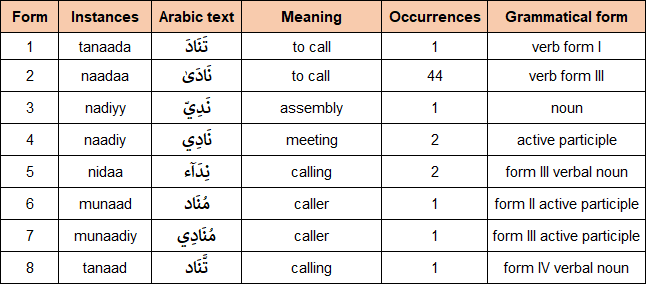
Note: The table is populated with data obtained from the Quran.corpus.com
- Details of instance of tanaada in verb form I meaning to call
[68:21] So, they (owners of gardens) had called one another at morning (fa-tanaadaw mus’biheena).
- Details of instances of naadaa in verb form III meaning to call
[3:39] Then the angels called him (Zakariya) (fa-naadat’hu al-malaaikatu) while he was standing to pray the salat prayer in the prayer house, “Indeed, God gives you a good news of John, confirming with a word from God, and an honorable and honest, and a prophet from the righteous.”
[3:193] Our Lord, indeed, we have heard a caller calls to the faith that (rabbanaa innanaa sami`naa munaadiyan yunaadiy lil’eemaani an) you shall believe in your Lord; so, we have believed. Our Lord, forgive our sins for us, and remove our evil deeds from us, and cause us to die with the righteous.
[5:58] And when you have called to the salat prayer (wa-idhaa naadaytum ilaa al-salati), they (from the people of scripture and the disbelievers) have taken it in ridicule and fun. That is of that they are a people who do not understand.
[7:22] Thus, he (the Satan) had misled both of them (Adam and his wife) by deception. Then when they both had tasted the tree, their shame became visible to both of them, and they both had begun to fasten over them from leaves of the Paradise. And their Lord had called them both (wa-naadaahumaa rabbuhumaa): “Did I not forbid you both from this – the tree, and say to you both that the Satan is an open enemy to you both?”
[7:43] And we have removed whatever of malice is in their breasts. There will flow the rivers from underneath of them, and they have said, “All praise belongs to God Who has guided us to this, and we had not been to be guided if not that God had guided us. That certainly, there had come messengers of our Lord with the truth, and they have been addressed that (wa-nuuduu an).” That is the Paradise you have been made to inherit it for what you have done to accomplish.
[7:44] And the companions of the Paradise had called out to the companions of the Fire that (wa-naadaa as’haabu al-jannati as’haabu al naari an) we have certainly found what our Lord had promised us is truth. So have you found what your Lord had promised is truth? They have said, “Yes.” Then an announcer between themselves has announced that God’s curse is on the wrongdoers.
[7:46] And between of them there will be a partition, and on the heights there will be a people who can recognize all (companions of Paradise and companions of Hell) by their marks. And they have called to companions of the Paradise that peace be upon you (wa-naadaw as’haaba al-jannati an salaamun `alaykum), they do not enter it (Paradise), while they are hoping.
[7:48] And the companions of the heights had called to a people whom they recognize by their marks, said (wa-naadaa as’haabu al-a`a’raafi rijaalan ya`a’rifuunahum bi-seemaahum qaaluu), “There has not availed yourselves of your great number from you, and from what you had been to be arrogant.”
[11:42] And it sailed with them in waves like the mountains, and Noah called his son (wa-naadaa nuuhun ib’nahu), while he had been in apart: “O my son, embark with us, and do not be with the disbelievers.”
[11:45] And Noah had called his Lord (wa-naadaa nuuhun rabbahu), then said: “O my Lord, indeed, my son is of my family, and indeed, Your promise is the truth, and You are just of the judges.”
[18:52] And a day He will say, “Call My partners, those whom you had claimed (naadaa shurakaaiya alladheena za`amtum).” Then they will call them, but they will not respond to them. And we will make a barrier between themselves.
[19:3] When he (Zakaria) had called to his Lord a secret calling (idh naadaa rabbahu nidaa-an khafiyyan).
[19:24] Then he (Jesus) had called to her from her beneath that do not grieve (fa-naadaahaa min tahtihaa allaa tah’zanee); your Lord has certainly placed a stream beneath of you.
[19:52] And we had called him (Moses) from the right side of the Mount (wa-naadaynaahu min jaanibi al-tuuri al-aymani), and we had brought him near for conversation.
[20:11] Then when he (Moses) had come to it, he had been called, “O Moses (nuudiya yaamuusaa).”
[21:76] And Noah when he had called before (wa-nuuhan idh naadaa min qablu), then we had responded to him, so we had saved him and his family from the great disaster.
[21:83] And Job when he had called to his Lord: indeed me, the adversity has touched me (wa-ayyuba idh naadaa rabbahu annii massaniya al-duru), and You have most mercy of the Merciful.
[21:87] And Dha al-Nun (Jonah) when he had abandoned being angry, then he had thought that we do not have authority over him. Then he had called in the darkness that there is no god except You (fa-naadaa fee al-zulumaati an laa-ilaaha illaa anta). Glory is Yours. Indeed, I have been among the wicked.”
[21:89] And Zakariya, when He had called to his Lord (wa-zakariya idh naadaa rabbahu): “My Lord, do not leave me without an heir, and You are the best inheritor.”
[26:10] And when your Lord had called Moses that (wa-idh naadaa rabbaka muusaa ani) you shall go to the people of the wrongdoers.
[27:8] So when he (Moses) had come to it, he had been called that (fa-lammaa jaa-ahaa nuudiya an) blessed has been whoever is in the fire and whoever is around it, and glory to God, Lord of the worlds.
[28:30] So when he had come to it, he had been called from the right side of the valley in the blessed even place from the tree that (nuudiya min shaati-i al-waadi al-aymani fee al-buq’`ati al-mubaarakati mina al-shajarati an) O Moses; indeed Me, I am God, Lord of the worlds.
[28:46] And you (prophet) had not been on the side of the Mount when we had called (Moses) (wa-maa kunta bi-jaanibi al-tuuri idh naadaynaa). But it is a mercy from your Lord that you may warn a people to whom no warner had come before of you so that they may take heed.
[28:62] And a day He will call them, then will say (wa-yawma yunaadeehim fa-yaquulu), “Where are My partners those whom you had done to claim?”
[28:65] And a day He will call them, then will say (wa-yawma yunaadeehim fa-yaquulu), “What have you answered to the sent ones?”
[28:74] And a day He will call them, then will say (wa-yawma yunaadeehim fa-yaquulu), “Where are My partners those whom you had done to claim?”
[37:75] And that certainly, Noah has called us (wa-laqad naadaanaa nuuhun), then surely, we have been best responders.
[37:104] And we had called him that O Abraham (wa-naadaynaahu an yaaib’raaheemu).
[38:3] How many a generation have we destroyed before of them? Then they had called when there had no time for escape (fa-naadaw wa-laata heena manaasin).
[38:41] And you shall recall our servant Job, when he had called to his Lord that the devil has afflicted me with illness and pain (idh naadaa rabbahu annii massaniya al-shaytaanu bi-nus’bin wa-`adhaabin).
[40:10] Indeed, those who had disbelieved will be called to them (inna alladheena kafaruu yunaadawna) that God’s hatred is greater than your hatred of yourselves when you were called to the faith (idh tud’`awna ilaa al-iimaani), then you disbelieved.
[41:44] And if we had made it a non-Arabic Quran that they would have said, “Why has not been detailed its verses?” Is it non-Arabic or Arabic? Say, “It is for those who have believed, is a guidance and a healing but those who do not believe, there is deafness in their ears and it is for them is blindness. Those are being called from faraway (ulaaika yunaadawna min makaanin ba`eedin).”
[41:47] To Him is referred the knowledge of the Hour. And no fruits emerge from their sheaths, nor does any female conceive or give birth except with His knowledge. And a day He will call them (wa-yawma yunaadeehim): “Where are My partners?” They have said, “We have proclaimed to You – there is no witness among us.”
[43:51] And Pharaoh declared among his people (wa-naadaa fir’`awna fee qawmihi); he said, “O my people, has not it been for me a kingdom of Egypt, and this of the rivers is flowing from my underneath? Do you not then see?
[43:77] And they had called (wa-naadaw): “O Malik, let your Lord put an end to us.” He said, “Indeed, you will be remaining (forever).
[49:4] Indeed, those who call you (prophet) from behind the walls (inna alladheena yunaaduunaka min waraa-i al-hujuraati), most of them do not understand.
[50:41] And listen, a day the caller will call from a near place (yawma yunaadi al-munaadi min makaanin qareebin).
[54:29] Then they had called their friend (fa-naadaw saahibahum), so he had taken and had slaughtered (the camel).
[57:14] They (hypocrites) will call them (believers) (yunaaduunahum), “Were not we with you?” They (believers) have said, “Yes, but you have tempted yourselves, and you have awaited, and you have doubted, while the wishful thinking had deceived you until God’s command had come. And the deceiver (Satan) had deceived you about God.”
[62:9] O you who have believed, when there has been called for the salat prayer on a day of the Friday (idhaa nuudiya lil’salati min yawmi al-jumu`ati), you shall hasten to remembrance of God, and shall leave the business. That is better for you, if you had done to know (it).
[68:48] So you (prophet) shall be patient for decision of your Lord, and do not be like a dweller of the fish when he had called while he was a distressed one (idh naadaa wa-huwa makzuumun).
[79:16] When his Lord had called him (Moses) in the holy valley of Tuwa (idh naadaahu rabbuhu bil-waadi al-muqaddasi tuwan).
[79:23] So, he (Pharaoh) had gathered, then he proclaimed (fa-hashara fa-naadaa).
- Details of instance of nadiyy in noun form meaning assembly
[19:73] When our clear revelations are recited to them, those who have disbelieved say to those who have believed, “Which of the two groups is better in position and best in meeting (ayyu al-fareeqayni khayrun maqaaman wa-ahsanu nadiyyan)?”
- Details of instances of naadiy in active participle form meaning meeting
[29:29] Do you indeed practice sex with the men and commit highway robbery and bring all kinds of vice in your gathering (wa-tatuuna fee naadiykumu al-munkara)? Then his (Lot) people had no answer except that they said, “Bring upon us God’s punishment, if you are of the truthful ones.”
[96:17] Then let him call his associates (fal-yad’`u naadiyahu).
- Details of instances of nidaa in form III verbal noun meaning calling
[2:171] And an example of those who have disbelieved is like an example of the one who shouts at what does not hear except call and crying (yan’`iqu bimaa laa-yas’ma`u illaa du`aa-an wa-nidaa-an) as deaf, dumb, blind, that they do not understand.
[19:3] When he (Zakariya) had called to his Lord a secret calling (idh naadaa rabbahu nidaa-an khafiyyan).
- Details of instance of munaad in form III active participle meaning caller
[50:41] And listen, a day the caller will call from a near place (yawma yunaadi al-munaadi min makaanin qareebin).
- Details of instance of munaadiy in form III active participle meaning caller
[3:193] Our Lord, indeed, we have heard a caller calls to the faith (rabbanaa innanaa sami`naa munaadiyan yunaadiy lil’eemaani) that you shall believe in your Lord; so, we have believed. Our Lord, forgive our sins for us, and remove our evil deeds from us, and cause us to die with the righteous.
- Details of instance of tanaad in form VI verbal noun meaning calling
[40:32] “And O my people; indeed me (Moses), I fear for you a day of the Calling (innii akhaafu `alaykum yawma al-tanaadi).”
The core messages from reviewing 53 instances of tanaada and its derived forms found in 50 verses of 26 surahs in the Quran are: the angels had called Zakariya when he was standing for the prayer; when it was called to the faith the believers have heard and believed it; when it has been called for the salat prayer from the people of scripture and the disbelievers have taken it in ridicule and fun; God called Adam and his wife when they had been deceived by the Satan; the people of the heights called out to a large number of people that do not help them for being arrogant; those whom had been associated with God will not respond when a day they have been called; Jesus had called to his mother from her beneath that your Lord placed a stream beneath her; God had called Moses from the right side of the Mount to bring him near for conversation; when Noah had called to his Lord, He responded to his call and saved him and his family from the great disaster; Zakariya called a secret calling to his Lord; Job called to his Lord when the adversity had touched him; Jonah had abandoned his Lord’s mission, then he was distressed and had called to his Lord in the darkness that there is no god except You; a day God will call and say the disbelievers what was your answer to the sent ones; a day God will call those who claim partners with Him and will say them where are My partners; God called Abraham when he had put down the forehead of his son; many generations were destroyed, when they had called then there was no time for escape; the wishful thinking had deceived the hypocrites until God’s command has come; it would be better for the believers if they hasten to remember God when has been called for the salat prayer on a day of the Friday; a caller will call from a near place on a day of the Calling.
This review followed by the review of instances of da’aa and its derived forms may help us understand the contexts for da`aa, which are very general that we do not call evil for good, nor do we call anyone with God, while the contexts for tanaada and its derived forms are specific being the historical as well as the future events and that a caller will call from a near place on a day of the Calling. However, under the prevailing circumstances this review may serve as a warning for the people that those whom they call other than God or are associating with Him will not respond on a day when they have been called, while the hypocrites are being deceived by their wishful thinking until God’s command has come that they may reform to avoid consequences when they meet their Lord.
Peaceful Friday, salaam and God bless.
Tafazzal (06/26/2026).