

rafa`a and its derived forms
There are 29 instances of rafa`a and its derided forms in the Quran, as shown in the table below according to their grammatical forms, which are reviewed to better understand their meanings in the different contexts:
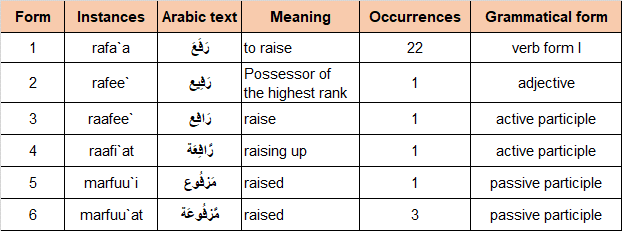
Note: The table is populated with data obtained from the Quran.corpus.com and `a denotes the Arabic letter ayn.
Details of instances of rafa`a
22 instances of `rafa`a meaning ‘to raise’ in the verb form I in 22 verses of 16 surahs in the Quran are reviewed here, while we know the Arabic word may have different meanings in different contexts:
[2:63] And when we had taken your covenant, and we had raised the Mount over you (wa-rafa`naa fawqakumu al-tuura): “You shall hold what we have given you with strength and shall remember what is in it so that you may be righteous.
[2:93] And when we had taken your covenant, and we had raised the Mount over you (wa-rafa`naa fawqakumu al-tuura): “You shall hold what we have given you with firmness and shall listen.” They said, “We have heard, but we have disobeyed.” And they had been made to drink the calf in their hearts because of their disbelief. Say, “It has been evil what your faith orders you with it, if you have been believers.”
[2:127] And when Abraham raised the foundations of the House, and Ismail (wa-idhaa yar’fa`u ibraahimu al-qawaa`ida mina al-bayti wa-is’maa`eelu): “Our Lord, accept from us; indeed You, You are the Hearer, the Knower.
[2:253] That is of the messengers, we had preferred of them over other. Of them there was whomever God had spoken to and He had raised of them in ranks (wa-rafa`a ba`dahum darajaatin). And we had given Jesus, son of Mary the clear proofs and had supported him with the Holy Spirit. And if God had willed, there would not have fought of those who were after of them after what had come to them the clear proofs; but they had differed that of them there was whoever had believed and of them there was whoever had disbelieved. And if God had willed, they would not have fought, but God does whatever He wills.
[4:154] And we had raised the mount above of them on their covenant (wa-rafa`naa fawqahumu al-tuura bi-meethaaqihim), while we said to them, “Enter the gate as prostrators,” and we said to them not to transgress in the Sabbath. And we had taken from them a solemn covenant.
[4:158] Nay, God has raised him (Jesus) to Him (bal rafa`ahu allahu ilayhi); and God has been Almighty, Wise.
[6:83] And that was our argument we had given it to Abraham against his people. We raise to higher ranks whomever we will (narfa`u darajaatin man shaa-u). Indeed, your Lord is Wise, Knower.
[6:165] And He is the One Who has made you inheritors of the earth, and He has raised of you above other in ranks (wa-rafa`a ba`da fawqa ba`din) so that He may test you with what He has given you. Indeed, your Lord is swift in the punishment, and indeed, He is surely Forgiving, Merciful.
[7:176] And if we had willed, surely, we could have raised him with them (wa-law shi`naa la-rafa`naahu bihaa), but he adhered to the earth and followed his desire. So, his example is like an example of the dog; if you scold him, he pants, or if you leave him, he pants. That is an example of the people who have denied in our revelations. So, you shall narrate the story that they may reflect.
[12:76] So he had begun with their bags before his brother’s bag, then he had brought it out from his brother’s bag. Thus that we had planned for Yusuf; he could not have taken his brother by law of the king, except that God wills. We raise ranks (in knowledge) for whomever we will (narfa`u darajaatin man nashaau), and we are Knower over every possessor of knowledge.
[12:100] And he had raised his parents upon the throne (wa-rafa`a abawayhi `alaa al-`Arshi), and they fell down as prostrators to him. And he said, “O my father, this is an interpretation of my dream before. Certainly, my Lord has made it truth, and certainly, He has been good with me, when He had taken me out of the prison and has brought with you from the desert after that the Satan had caused discord between me and my brothers. Indeed, my Lord is Benignant to what He wills. Indeed, He is the Knower, the Wise.”
[13:2] God is the One who has raised the heavens without pillars (allahu alladhee rafa`a al-samaawaati bi-ghayri `amadin), you see them; then He has established on the Throne. He has subjected the sun and the moon, each running for an appointed term. He manages all the matter; He details the revelations that you may believe with certainty in the meeting of your Lord.
[19:57] And we had raised him (Idris) to a high position (wa-rafa`naahu makaanan `aliyyan).
[24:36] In houses (of the believers), God has ordered that His name is raised and mentioned in them (adhina allahu an tur’fa`a wa-yudh’kara feehaa us’muhu). Glorifies for Him in them in the mornings and the evenings.
[35:10] Whoever may have desire for the honor, then to God belongs all the honor. To Him ascends the good words and the righteous deed raises it (wal-`amalu al-saalihu yarfa`uhu). And those who would plot the evil, for them there is a severe punishment, and plotting of those – it will perish.
[43:32] Do they distribute mercy of your (prophet) Lord? We have distributed their livelihood between themselves in the life of the world, and we have raised of them over other in ranks (wa-rafa`naa ba`dahum fawqa ba`din) that one may take service of them from other. And your Lord’s mercy is better than what they hoard.
[49:2] O you who have believed, you do not raise your voices above the voice of the prophet (tarfa’uu aswaatakum fawqa sawti al-nabiyi), nor do you be loud to him in the speech like the loudness of yourselves to other that it nullifies your deeds while you do not perceive.
[55:7] And the heaven He has raised it (wal-samaa-a rafa`ahaa) and has set up the balance (law).
[58:11) O you who have believed, when it has been said to you, “Make room in the assemblies,” then you shall make room for you, God will make room for you. And when it has been said, “Rise up,” then you shall rise up, God will raise those who have believed among you (yarfa`i allahu alladheena aamanuu minkum), and those who have been given the knowledge in ranks. And God is Cognizant of what you do.
[79:28] He raised its ceiling as He had designed it (rafa`a samkahaa fa-sawwaahaa).
[88:18] And (look) towards the sky how has it been raised (wa-ilaa al-samaa-i kayfa rufi`at)?
[94:4] And we have raised your remembrance (wa-rafa`naa laka dhik’raka).
Details of instance of rafee`
[40:15] Possessor of the highest ranks (rafee`u al-dirajaati), Owner of the Throne places the inspiration of His command upon whomever He wills of His servants that he may warn about a day of the Meeting.
Details of instance of raafi`
[3:55] When God said, “O Jesus, indeed Me, I am Terminator of you and Raiser of you to Me (innii mutawaffika wa-raafi`uka ilayya), and Purifier of you from those who have disbelieved, and I am Maker of superior of those who have followed you (Jesus) to those who have disbelieved on a day of the Resurrection. Then to Me is all your return, then I will judge between of you in what you had done to differ in it.”
Details of instance of raafi`at
[56:3] There are those who will be bringing down; there are those who will be raising up (khaafidatun raafi`atun).
Details of instance of marfuu`i
[52:5] And the raised ceiling (wal-saqfi al-marfuu`i).
Details of Instances marfuu`at
[56:34] And raised couches (wa-furushin marfuu`atin).
[80:14] Exalted, purified (marfuu`atin mutahharatan).
[88:13] Therein will be the raised thrones (feehaa sururun marfuu`atun).
Reviewing 29 instances of rafa`a and its derived forms confirms the important messages about the death of Jesus that God has raised him to Himself being He is Terminator and Raiser of him eliminating any controversy about his death and second coming, and He has ordered that His name is raised and mentioned in every house of the believers to glorify Him in the mornings and the evenings holding what has been given us with firmness and listening, and He had given opportunity for the prophet to raise for His remembrance. He raises position/honor to anyone whomever He wills, and has raised the heavens without pillars confirming our meeting with Him.
Review instances of faday and its derived forms
There are 13 instances of faday and its derided forms in the Quran, as shown in the table below according to their grammatical forms, which are reviewed to better understand their meanings in the different contexts:
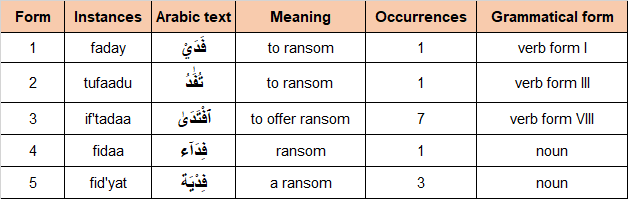
Note: The table is populated with data obtained from the Quran.corpus.com and `a denotes the Arabic letter ayn.
Details of instance of faday
[37:107] And we had ransomed him with a great sacrifice (wa-fadaynaahu bi-dhib’hin `azeemin).
Details of instance of tufaadu
[2:85] Then you are those – you kill yourselves and evict a party of you from their homes, supporting one another against them in the sin and the transgression. And if they come to you as captives, you ransom them (wa-in yatuukum usaaraa tufaaduuhum), while it has been forbidden for you their eviction. So, do you believe in part of the scripture and disbelieve in part? Then what is recompense for whoever does that among you, except a disgrace in the life of the world, and on a day of the Resurrection they will be returned to the most severe punishment? And God is not unaware of what you do.
Details of instances of if’tadaa
[2:229] The divorce is permitted twice. Then either retaining in an amicable manner, or releasing with kindness. And it is not lawful for you (husbands) to take back anything from what you have given them (wives) anything except that they both fear that they cannot keep God’s limits. But if you have feared that they cannot keep God’s limits, then there is no sin on both of them in what she has ransomed of it (fa-laa-junaaha `alayhimaa feemaa if’tadat bihi). That is of God’s limits you do not transgress it, while whoever transgresses God’s limits, then those – they are the wrongdoers.
[3:91] Indeed, those who have disbelieved, and have died while they are disbelievers, then the earth full of gold will not be accepted from anyone of them, even if he had offered ransom with it (wa-lawi if’tadaa bihi). Those – for them there is a painful punishment and not for them there are any helpers.
[5:36] Indeed, those who have disbelieved, if that for them what is in the earth all, and like of it with it that they ransom with it (law anna lahum maa fee al-ardi jamee`an wa-mith’lahu ma`ahu) li’yaftaduu bihi) from a punishment on a day of the Resurrection, has not been accepted from them, and for them there is a painful punishment.
[10:54] And if that for every soul that had wronged, whatever is in the earth that it would have sought to ransom with it (maa fee al-ardi la’if’tadat bihi), and they would have confided the regret when they have seen the punishment. And they have been judged between themselves with the justice, and they will not be wronged.
[13:18] The best for those who have responded to their Lord, and those who do not respond to Him, if that they had all whatever is in the earth and like of it with it, that they would have offered ransom with it (law anna lahum maa fee al-ardi jamee`an wa-mith’lahu ma`ahu la’if’tadaw bihi) – those for them the reckoning will be terrible, and their abode is Hell and it has been miserable of the resting place.
[39:47] And if that for those who have done wrong, whatever all is in the earth and like of it with it they had ransomed with it (maa fee al-ardi jamee`an wa-mith’lahu ma`ahu la’if’tadaw) from an evil of the punishment on a day of the Resurrection, while it would have appeared to them from God what they would not take into account.
[70:11] It would be made to seem them – the criminal would wish, if he could offer ransom from a punishment of that day by his children (law yaf’tadee min `adhaabi yawmi-idhin bi-baneehi).
[70:12] And his spouse and his brother (wa-saahibatihi wa-akheehi).
[70:13] And his nearest relative who shelters him (wa-faseelatihi allatee tu`wihi).
[70:14] And whoever in the earth all, then it could save him (wa-man fee al-ardi jamee`an thumma yunjeehi).
Details of instance of fidaa
[47:4] So, when you have encountered those who have disbelieved, is striking on the necks until when you have defeated them. Then you shall take as the captives, then either is a favor afterwards or a ransom until the war lays down its burdens of that (wa-immaa fidaa-an hattaa tada`a al-harbu awzaarahaa dhaalika). And if God had willed, surely, He could have given victory from them; but that is to test of you by other. And those who have been killed in a path of God, then He will not let go waste of their deeds.
Details of instances of fid’yat
[2:184] A specified number of days. So whoever has been sick among you, or on a journey, then a specified number from other days. And on those who can afford it would be a ransom of feeding a poor (fid’yatun ta`aamu mis’kinin), but whoever has volunteered good, then it would be better for him. And that fasting is better for you, if you have done to know.
[2:196] And you shall complete the Hajj and the `Umrah for God. So, if you have been prevented, then whatever he has obtained with ease of the animal for offering, and you cannot shave your heads until the animal for offering reaches its place of sacrifice. So, whoever among you has been ill or with an ailment of his head, then a ransom of fasting or charity or sacrifice (fa-fid’yatun siyaamin aw sadaqatin aw nusukin). So, when you have been secure, then whoever he has taken advantage of the `Umrah to the Hajj, then whatever he has obtained with ease of the animal for offering. But whoever cannot find, then fasting of three days during the Hajj and seven when you have returned. That is ten in all; that is for whoever of his family would not be near the Sacred Masjid. And you shall fear God, and shall know that God is severe in the retribution.
[57:15] “So, today no ransom will be accepted from you (fa-al-yawma laa-yu’khadhu minkum fid’yatun), nor from those who had disbelieved. Your abode is the Fire; it is your protector, and has been miserable is the destination.”
Reviewing 13 instances of faday and its derived forms confirms the important message about the painful punishment of the disbelievers on a day of the Judgment, even offering of any ransom would not be accepted from them and their abode is Hell, which is a miserable destination for the disbelievers and the criminals, but a ransom of fasting or charity or sacrifice is acceptable to God when a pilgrim cannot not find an animal for offering, while fasting of three days during the Hajj and seven days when he has returned home.
Briefly, the messages from the review of instances of rafa`a may help us to raise our position with God avoiding the controversy around the death of Jesus, while the messages from the review of instances of faday may help us to save us from the painful punishment in the Hell that on a day we would not have to think to offer ransom our children, spouses, brothers, nearest relatives and all whoever in the earth, even it would not be acceptable to God.
Peaceful Friday, salaam and God bless.
Tafazzal (03/20/2026).