

There are 70 instances of `arafa and its derived forms in the Quran as shown in the table below based on their grammatical forms, which are reviewed to better understand their meanings in different contexts, while we know that the Arabic words may have different meanings in the different contexts:
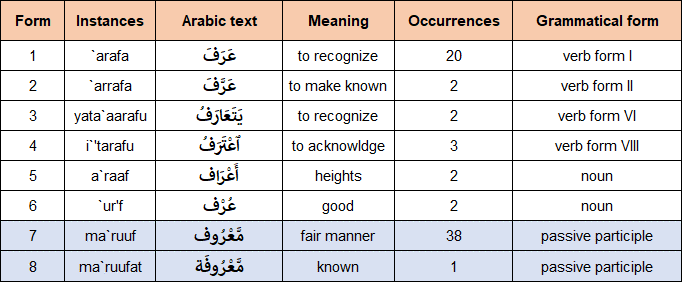
Note: The above table is populated with data obtained from the corpus.quran.com.
Here are reviewed 39 instances to better understand their meanings in different contexts:
- Details of instances of ma`ruuf in passive participle meaning fair manner
[2:278] O you who have believed, it has been prescribed upon you the legal retribution concerning the killed: the free man for the free man, and the slave for the slave, and the female for the female. So whoever has been pardoned anything for him by his brother, then there is a following up with fairness (fa-`ittabaa`un bil-ma`ruufi) and a payment to him with goodness. That is a lessening from your Lord and a mercy. So whoever transgresses after that, then for him there is a painful punishment.
[2:180] It has been prescribed upon you, when death approaches one of you — if he leaves wealth — that he shall make a will for his parents and near relatives with fairness (al-wasiyatu lil’waalidayni wal-aqrabeena bil-ma`ruufi). This is a duty upon the righteous.
[2:228] And the divorced women shall wait three monthly periods for themselves. And it is not lawful for them that they conceal what God has created in their wombs, if they believe in God and the Last Day. And their husbands have more right to take them back during that period if they wish for reconciliation. And for them is a right similar to that which is upon them with fairness (wa-la-hunna mith’lu alladhee `alayhinna bil-ma`ruufi), while for the men there is a degree over them. And God is Almighty, Wise.
[2:229] The divorce is permitted twice. Then either retaining them in an amicable manner (fa-im’saakun bi-ma`ruufin), or releasing them with kindness. And it is not lawful for you to take back anything from what you have given them, except that they both fear that they cannot keep God’s limits. But if you have feared that they cannot keep God’s limits, then there is no sin on both of them in what she has ransomed herself with. These are God’s limits, so do not transgress them; while whoever transgresses God’s limits, then those – they are the wrongdoers.
[2:231] And when the men have decided to divorce the women and they have reached their term, then you shall either retain them in a fair manner (fa-amsikuuhunna bi-ma`ruufin) or shall release them in a fair manner (aw sarrihuuhunna bi-ma`ruufin). And you do not retain them for hurting that you transgress, and whoever does that, then indeed, he has wronged his own soul. And you do not take God’s revelation in mockery and shall remember God’s favors upon you and what He has sent down to you from the scripture and the wisdom, instructing you with it. And you shall fear God and shall know that God is the Knower of everything.
[2:232] And when you have divorced women and they have fulfilled their interim, then do not prevent them from marrying their (former) husbands when they have agreed between themselves in a fair manner (idhaa taraadaw baynahum bil-ma`ruufi). That is what is admonished to whoever among you believes in God and the Last Day. That is better for you and purer, while God knows and you do not know.
[2:233] The mothers shall suckle their children for two full years for whoever has wished to fulfill the suckling. And upon the father is their provision and their clothing in a fair manner (wa-kis’watuhunna bil-ma`ruufi). No soul is burdened beyond its capacity. Neither a mother because of her child shall be made to suffer, nor a father because of his child. And upon the heir is a similar duty. But if they both desire weaning by mutual consent and consultation, then there is no sin on both of them. And if you intend to hire nursing mothers to suckle your children, then there is no sin upon you when you have paid what you agreed to give in a fair manner (maa aataytum bil-ma`ruufi). And you shall fear God and shall know that God is the Seer of what you do.
[2:234] And those who passed away among you and left behind wives, they shall wait four months and ten days for themselves. Then when they have fulfilled their term, there is no sin upon you in what they do concerning themselves in a fair manner (feemaa fa`al’na fee anfusihinna bil-ma`ruufi). And God is Cognizant of what you do.
[2:235] And there is no sin upon you about what you have indicated concerning a marriage proposal to the women, or what you have concealed within yourselves. God knows that you will mention them, but do not promise them in secret, except that you say a decent word (illaa an taquuluu qawlan ma`ruufan). And do not resolve on the bond of marriage until the prescribed term reaches its end. And you shall know that God knows what is in yourselves, so you shall be aware of Him. And you shall know that God is Forgiving, Forbearing.
[2:236] There is no sin upon you if you have divorced the women whom you have not touched, or have not settled a dowry for them. And you shall provide for them – upon the wealthy according to his means and upon the poor according to his means – a provision in a fair manner, a duty upon the good-doers (mataa`an bil-ma`ruufi haqqan `alaa al-muh’sineena).
[2:240] And those who passed away among you and left behind wives shall make a will of provision for their wives for a year without driving them out. But if they leave on their own, then there is no sin upon you in what they do concerning themselves in a fair manner (feemaa fa`al’na fee anfusihinna min ma`ruufin). And God is Almighty, Wise.
[2:241] And for the divorced women there shall be a provision in a fair manner – a duty upon the righteous (mataa`un bil-ma`ruufi haqqan `alaa al-muttaqeena).
[2:263] A kind word and forgiveness are better than a charity (qawlu ma`aruufun wa-maghfiratun khayrun min sadaqatin) that is followed by an insult. And God is Rich, Forbearing.
[3:104] And let there be a community from among you that invites to good, enjoins the just, and forbids evil (yad’`uuna ilaa al-khayri wa-yamuruuna wa-bil-ma`ruufi wa-yanhawna `anil al-munkari). And those – they are the successful ones.
[3:110] You have been the best community that was raised for the people: you enjoin the just, and forbid the evil, and believe in God (tamuruuna bil-ma`ruufi wa-tanhawna `anil al-munkari wa-tu’minuuna billahi). And if the people of the scripture had believed, surely, it would have been better for them. Of them there are the believers, while most of them are the disobedient.
[3:114] They believe in God and the Last Day, and enjoin the just, and forbid the evil, and hasten in the good deeds (wa-yamuruuna bil-ma`ruufi wa-yanhawna `anil al-munkari wa-yasaari`uuna al-khayraati). Those are among the righteous.
[4:5] And do not give the immature your wealth, which God has made a means of support for you, and provide for them from it and clothe them, and speak to them a kind word (wa-quuluu lahum qawlan ma`ruufan).
[4:6] And test the orphans until when they have reached the age of marriage; then if you have deemed in them sound judgment, hand over their wealth to them. And do not consume it in extravagance and haste before they grow up. And whoever has been rich, let him refrain, but whoever has been poor, then let him consume in a fair manner (fal-yakul bil-ma`ruufi). Then when you hand over their wealth to them, take witnesses over them. And it has sufficed with God as a Reckoner.
[4:8] And at the time of distribution, if there have been present the near relatives, and the orphans, and the poor, then give them a portion from it and speak to them a kind word (wa-quuluu lahum qawlan ma`ruufan).
[4:19] O you who have believed, it is not lawful for you to inherit women by force, nor should you constrain them that you may take a part of what you have given them, except if they commit a proven adultery. And live with them with kindness (wa-`aashiruuhunna bil-ma`ruufi). But if you dislike them, then it may be that you dislike a thing while God places a lot of good in it.
[4:25] And whoever among you is not able to marry the believing free women, then he may marry from what your right hands have possessed of your believing slave girls. And God knows best about your faith; you are part of one another. So marry them with the permission of their family and give them their dowries in a fair manner (wa-aatuuhunna ujuurahunna bil-ma`ruufi) —they being chaste, not committing adultery, nor taking secret lovers. Then when they have been married, if they commit adultery, then for them is half of the punishment that is for the free chaste women. That is for whoever among you fears committing sin, and that you be patient is better for you. And God is Forgiving, Merciful.
[4:114] There is no good in much of their private talk except whoever has ordered with charity, or kindness, or conciliation between the people (aw ma`ruufin aw is’laahin bayna al-nnasi). And whoever does that seeking a pleasure of God, then we will give him a great reward.
[7:157] Those who follow the messenger, the gentile prophet whom they find written with them in the Torah and the Gospel. He commands them to the right and forbids them from evil (yamuruhum bil-ma`ruufi wa-yanhaahum `anil al-munkari); and he makes lawful for them the good things and makes unlawful for them the bad things; and he relieves them of their burdens and the shackles which were upon them. So, those who have believed in him, and have honored him, and have helped him, and have followed the light revealed with him—those, they are the successful ones.
[9:67] The hypocrite men and the hypocrite women are with one another; they enjoin evil and forbid the right (yamuruuna bil-munkari wa-yanhawna `ani al-ma`ruufi), and they withhold their hands. They have forgotten God, so He has forgotten them. Indeed, the hypocrites – they are the disobedient.
[9:71] And the believing men and the believing women are allies of them to other; They enjoin the right and forbid evil (yamuruuna bil-ma`ruufi wa-yanhawna `ani al-munkari), and they establish the salat prayer and give the zakat, and they obey God and His messenger. Those – God will have mercy on them; indeed, God is Almighty, Wise.
[9:112] The repenters, the worshipers, the praisers, the wanderers, the bowers, the prostrators, the enjoiners of the right (yamuruuna bil-ma`ruufi) and the forbidders of the wrong, and the keepers of the limits of God—and give good news to the believers.
[22:41] Those who – if we established them in the earth, they would have established the salat prayer and would have given the zakat, and would have enjoined the right (wa-amaruu bil-ma`ruufi), and would have forbidden evil. And to God is the end of all matters.
[31:15] And if they strive against you to make you associate partners with Me that of which you have no knowledge, then do not obey them. But accompany them in the world with kindness (wa-saahib’hunna fee al-dun’yaa ma`ruufan), and follow the path of whoever has turned to Me. Then to Me is your return, and I will inform you of what you have been doing.
[31:17] “O my son, establish the salat prayer, and enjoin the right (wa-mur bil-ma`ruufi) and forbid evil, and be steadfast over what has befallen you. Indeed, that is from the matters of determination.”
[33:6] The prophet is closer to the believers than themselves, and his wives are their mothers. And possessors of relationships are closer to one another in the decree of God than the believers and the emigrants, except that you do a kindness to your friends (illaa an taf’`aluu illaa awliyaaikum ma`ruufan). That has been written in the scripture.
[33:32] O wives of the prophet, you have not been like anyone among women. If you have feared God, then do not be soft in speech, lest whoever has a disease in his heart should move with desire; and speak a right word (wa-qul’na qawlan ma`ruufan).
[47:21] Obedience and a right word (taa`atun wa-qawlun ma`ruufun). Then when the matter has been determined, if they had been truthful to God, surely it would have been better for them.
[60:12] O Prophet, when the believing women have come to you pledging to you that they will neither associate anything with God, nor will they steal, nor will they commit adultery, nor will they kill their children, nor will they bring a slander they invent between their hands and their feet, nor will they disobey you in what is right (wa-laa-ya`seenaka fee ma`ruufin) -—then accept their pledge and ask forgiveness of God for them. Indeed, God is Forgiving, Merciful.
[65:2] So when they have reached their term, then retain them with fairness (fa-amsikuuhunna bi-ma`ruufin) or release them with fairness (aw faariquhunna bi-ma`ruufin). And take witness of two just men from among you and establish the testimony for God. That is what is admonished to whoever believes in God and the Last Day; and whoever fears God, He will make a way out for him.
[65:6] Give them housing where you have lived according to your means, and do not harm them to distress them. And if they have been pregnant, then spend on them until they deliver their burden. Then if they have suckled for you, then give them their reward, and consult between yourselves with fairness (wa-tamiruu baynakum bi-ma`ruufin); and if you have disagreed, then another woman will suckle for him.
- Details of instance of ma`ruufat in passive participle meaning known
[24:53] And they have sworn by God their solemn oaths that if you had commanded them, they would go forth. Say, “Do not swear; obedience is a known obligation (taa`atun ma`aruufatun). Indeed, God is Cognizant of what you do.”
Reviewed 39 instances of `arafa and its derived forms in 36 verses of 12 surahs in the Quran: the legal retribution concerning the killed; he who leaves wealth shall make a will with fairness; in case of the divorced couple the husband has more right to take back her while she has a similar right with fairness; the divorce is permitted twice; when the men have decided to divorce the women, then they shall either retain them in a fair manner or shall release them in a fair manner; it is not lawful to prevent former wives from marrying their former husbands; mothers will suckle their children for two full years when upon fathers are their provision and their clothing in a fair manner; widows shall wait for 4 months and 10 days to decide anything about themselves; no sin for the men to indicate a marriage proposal to the women but no promise in secret except a descent word; the divorced women who have not been touched, a settle of her dowery according to his means; you shall make a will of provision for a year for the widows and there shall be a provision for the divorced women in a fair manner; a kind word and forgiveness are better than a charity followed by insult; God wishes that there should be a community from among us that invites to good, enjoins the just and forbids the evil; He has ordered us not to give immature the wealth and to test the orphans until when they reach the age of marriage; at the time of distribution give a portion to the near relatives, the orphans and the poor from it; it is not lawful to inherit the women by force, nor should you take back a part of what you have given them, except if they commit a proven adultery; whoever cannot marry a free woman can marry slave girl giving her dowery in a fair manner, those are successful who have followed the light revealed with the messenger, the gentile prophet; the hypocrite men and women enjoin evil and forbid the right; good news to the believers who are the keepers of the limits of God; those who are established in the earth establish the salat prayer, give the zakat, enjoin the right and forbid evil; God wants us to follow the path of those who have turned to Him knowing that to Him is our return; the prophet and his wives are closer to the believers, while the relationship which is written in the scripture is a decree of God than the believers and the emigrants, except we may do a kindness to our friends, obedience and a right word would have been better if they have been truthful to God when the matter has been determined; when the women have reached their term, retain them with fairness or release them with fairness taking witness of two just men who have established the testimony for God; the men shall give the divorced women their housing and will consult with them about the care of their child, and no need to swear by God to do anything as obedience is a known obligation to Him, He is aware of it.
God has given us clear divorce laws to keep us on the right path. True success belongs to those who follow the light revealed with the prophet, doing good and standing against wrong.
Peaceful Friday, salaam and God bless.
Tafazzal (9/11/26)