

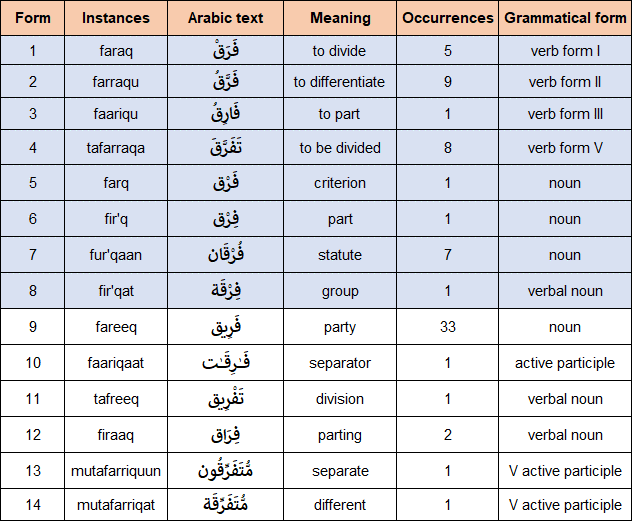
Note: The above table is populated with data obtained from the corpus.quran.com.Out of 72, 33 instances are reviewed below to better understand their meanings in different contexts:
- Details of instances of faraqa in verb form I meaning to divide
[2:50] And when we had parted the sea for you, then we saved you and we drowned the people of Pharaoh while you were watching.
[5:25] He said, “My Lord, indeed, I do not possess power except for myself and my brother. So, separate between us and the disobedient people.”
[9:56] And they swear by God that they are surely with you, while they are not with you; but they are a people who tremble with fear.
[17:106] And a Quran we have divided, that you may recite it to the people over a period of time; and we have sent it down, a gradual sending down.
[44:4] In it, every wise matter is made distinct.
- Details instances of farraqu in verb form II meaning to differentiate
[2:102] And they followed what the devils recited during the kingdom of Solomon, and Solomon did not disbelieve, but the devils disbelieved. They taught people magic, and what had been sent down upon the two angels in Babylon, Harut and Marut. And they did not teach anyone until they had said, ‘We are only a test, so do not disbelieve.’ So, they learned from those two that by which they cause separation between a man and his spouse. But they could not harm anyone with it except by permission of God. And they learned what harms them and does not profit them. And certainly, they knew that whoever purchased it would have no share in the Hereafter. And evil has been that for which they sold themselves, if they only knew.
[2:136] Say, “We have believed in God, and what has been sent down to us, and what has been sent down to Abraham, and Ishmael, and Isaac, and Jacob and the Tribes; and what was given to Moses and Jesus, and what was given to the prophets from their Lord—we do not make distinction between any of them, and we to Him are Submitters.”
[2:285] The messenger has believed in what has been sent down to him from his Lord, and so have the believers. Each one has believed in God, and His angels, and His scriptures, and His messengers: “We do not make distinction between any of His messengers,” and they said, “We have heard and we have obeyed. Your forgiveness, our Lord, and to You is the return.”
[3:84] Say, “We have believed in God, and what has been sent down to us, and what has been sent down to Abraham, and Ishmael, and Isaac, and Jacob, and the Tribes, and what was given to Moses, and Jesus, and the prophets from their Lord—we do not make distinction between any of them, and we to Him are submitters.”
[4:150] Indeed, those who disbelieve in God and His messengers, and they wish that they make distinction between God and His messengers, and they say, “We believe in one and disbelieve in other.” And they wish that they accept a path between that.
[4:152] And those who have believed in God and His messengers, and do not make distinction between any of them—those, He will give them their rewards. And God has been Forgiving, Merciful.
[6:159] Indeed, those who have divided their religion and become sects, you are not with them in anything. Their matter is only with God, then He will inform them of what they had been doing.
[20:94] He said, “O son of my mother, do not grab me by my beard nor by my head. Indeed, I feared that you would say, ‘You have caused division between the Children of Israel, and you did not observe my word.’”
[30:32] Of those who have divided their religion and become sects—each party rejoicing in what they have.
- Details of instance of farriqu in verb form III meaning to part
[65:2] So, when they have reached their term, then retain them with fairness or separate from them with fairness. And take as witness two just men from among you and establish the testimony for God. That is what is admonished to whoever believes in God and the Last Day; and whoever fears God, He will make a way out for him.
- Details if instance of tafarraqa in verb V meaning to be divided
[3:103] And hold fast to the rope of God all together, and do not be divided. And remember the favor of God upon you when you were enemies, then He brought hearts together in friendship, and by His favor you became brothers. And you were on the brink of a pit of the Fire, then He saved you from it. Thus God makes clear His revelations for you, that you may be guided.
[3:105] And do not be like those who have become divided and have differed after the clear proofs have come to them. And those—for them is a great punishment.
[4:130] And if they get separated, God will enrich each from His abundance; and God has been All-Encompassing, Wise.
[6:153] And that this is My path, straight; so, follow it, and do not follow the other paths, for they will separate you from His path. That is what He has enjoined upon you with it, that you may fear.
[30:14] And the day the Hour takes place—that day they will get separated.
[42:13] He has decreed for you of the religion what He had enjoined upon Noah, and what We have inspired to you, and what We had enjoined upon Abraham, and Moses, and Jesus: “That you shall establish the religion and do not be divided in it.” Grave has been upon the idol worshipers that to which you call them. God chooses for Himself whomever He wills, and He guides to Himself whoever turns [to Him].
[42:14] And they did not become divided except after knowledge had come to them, out of animosity between them. And if a word from your Lord had not preceded for a specified term, it would surely have been settled between them. And indeed, those who had been made to inherit the scripture after them are surely in a disquieting doubt concerning it.
[98:4] And those who had been given the scripture did not become divided except after the clear proof had come to them.
- Details of instance of farq in noun form meaning criteria
[77:4] And those (angels) who record good and evil.
- Details of instance of fir’q in noun form meaning part
[26:63] Then we had inspired to Moses that you shall strike the sea with your staff, so it had parted that each part had become like the great mountain.
- Details of instances of fur’qaan in noun form meaning statute
[2:53] And when we had given Moses the scripture and the statute book that you may be guided.
[2:185] Ramadan is the month in which the Quran has been sent down as guidance for mankind, and clear proofs of guidance, and the statute book. So, whoever has witnessed the month from you, then he shall fast in it and whoever has been sick or on a journey, then a specified number from other days. God does intend the ease for you and He does not intend the hardship for you, and that you may complete the specified number; and that you may glorify God through which He has guided you, and that you may appreciate.
[3:4] Before of (it) there was guidance for the people, and He had sent down the statute book. Indeed, those who have disbelieved in God’s revelations, for them there is a severe punishment, and God is Almighty, Possessor of retribution.
[8:29] O you who have believed, if you fear God, He will grant you wisdom and will remove your evil deeds from you and will forgive for you. And God is Possessor of the great bounty.
[8:41] And you shall know that what you have obtained war spoils from anything, then that one-fifth of it belongs to God and to the messenger, and to the near relatives and the orphans and the poor and the traveling alien, if you have believed in God and in what we have sent down to our servant about a day of the decision, a day has met the two parties. And God has power over everything.
[21:48] And that certainly, we had given Moses and Aaron the statute book, a light, and a reminder for the righteous.
[25:1] Blessed is the One who has sent down the statute book to His servant (Muhammad) that it may be a warner for the people of the world.
- Details of instance of fir’qat in verbal noun meaning group
[9:122] And it has not been for the believers that they go forth all together; so why not has gone forth a company from every group among them that they may obtain understanding in the religion and that they may warn their people when they have returned to them, so that they may be aware.