

The salat prayer is the greatest way to remember God that we may protect us from evil deed and behavior (29:45), while adhaan meaning announcement and mu-adhin meaning announcer are two terms extensively used in connection with the salat prayer. But often we hear that these Arabic words are not found in the context with the commandment of the salat prayer. Here are details of instances of adhana and its derived forms in the Quran that we may have any hint to address this dispute in light of the Quran:
There are 10 instances of adhana and its derided forms in the Quran, as shown in the table below according to their grammatical forms, which are detailed to better understand their meanings in the different contexts:
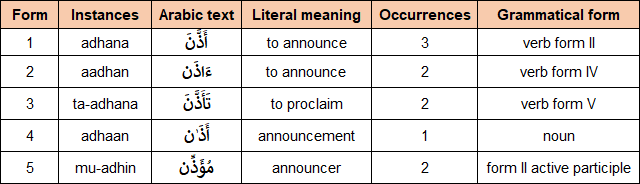
Note: The table is populated with data obtained from the Quran.corpus.com.
- Details of instances of adhana meaning “to announce” in form II verb
[7:44] And the companions of the Paradise had called out to the companions of the Fire that we have certainly found what our Lord had promised us is truth. So, have you found what your Lord had promised is truth? They have said, “Yes.” Then an announcer between themselves has announced that (fa-adhana mu-adhinun baynahum an) God’s curse is on the wrongdoers.
[12:70] Then when he had provided them with their provisions, he placed the drinking cup in his brother’s bag, then an announcer had announced (thumma adhana mu-adhinun), “O you the caravan, you are surely thieves.”
[22:27] And you (Abraham) shall announce to the people of the Pilgrimage (wa-adhin fee al-naasi bil-haji); they will come to you on foot and by every transport; they will come from every distant place.
- Details of instances of aadhan meaning “to announce” in verb form IV
[21:109] So, if they have turned away, then say, “I (prophet) have announced to you on a revenge (aadhantukum `alaa sawaain), while I do not know whether it is near or far what you are promised?”
[41:47] To Him is referred the knowledge of the Hour. And no fruits emerge from their sheaths, nor does any female conceive or give birth except with His knowledge. A day He will call them: “Where are My partners?” They have said, “We have proclaimed to You – there is no witness among us (aadhannaaka maa minnaa min shaheedin).”
- Details of instances of ta-adhana meaning “to proclaim” in verb form V
[7:167] And when your Lord has proclaimed that He will surely send upon them (wa-idh ta-adhana rabbuka li’yab’`athanna `alayhim) until a day of the Resurrection what will inflict them a grievous of the punishment. Indeed, your Lord is surely swift in the retribution, while indeed, He is surely Forgiving, Merciful.
[14:7] And when your Lord has proclaimed (wa-idh ta-adhana rabbuka) that if you have been thankful, that I will surely increase for you, and that if you have been unthankful, indeed, My punishment will surely be severe.
- Details of instance of adhaan meaning “announcement” in noun form
[9:3] And an announcement from God and His messenger to the people (wa-adhaanun mina allahi wa-rasuulihi ilaa al-naasi) on a day of the greater pilgrimage that God is free of any obligation to the idol worshipers and so is His messenger. So, if you have repented, then it would be better for you, and if you have turned away, then know that you have no escape from God. And give a (bad) news of a painful retribution to those who have disbelieved.
- Details of instances of mu-adhin meaning “announcer” in active participle form
[7:144] And the companions of the Paradise had called out to the companions of the Fire that we have certainly found what our Lord had promised us is truth. So, have you found what had promised your Lord is truth? They have said, “Yes.” Then an announcer between themselves has announced that (fa-adhana mu-adhinun baynahum an) God’s curse is on the wrongdoers.
[12:70] Then when he had provided them with their provisions, he placed the drinking cup in his brother’s bag, then an announcer had announced (thumma adhana mu-adhinun), “O you the caravan, you are surely thieves.”
The core messages from reviewing 10 instances of adhana and its derived forms in 9 verses of 7 surahs in the Quran are: On a day of the Judgment an announcer from the disbelievers will announce God’s curse upon the wrongdoers; an announcer announced that there were thieves among the caravan; to whom was assigned the site of the House is to announce to the people on the pilgrimage that they will come to him on foot and any other transport from distant places; prophet announces the punishment for those who turned away from God’s revelation; those who associated partners with God will declare to Him on a day of the Judgment that there are no witnesses among them; God has proclaimed punishment on the disbelievers until a day of the Resurrection; He proclaimed to the people of Moses if you are grateful, He will increase reward for you, but if you are ungrateful, His punishment will be severe for you; an announcement from God and His messenger on a day of the great Hajj that God is free from any obligation to the idol worshipers and His messenger as well, while if they had repented, it would have been better for them.
It is notable that adhaan meaning announcement and mu-adhin meaning announcer are found in different contexts in the Quran, but not in the context of call and caller to the salat prayer, while these two terms, adhaan and mu-adhin are in use in connection with the salat prayer. However, what we know from the Quran that there is mention of naaday in the perfect tense to call for the salat prayer in 5:58, nuudiya in the passive perfect tense to call for the salat prayer on a day of the Friday in 62:9, and munaadiy in the active participle form meaning a caller in 3:193, which are derived from form III verb naadaa meaning to call. We may consider the voice to pray the salat prayer, which is moderate as mentioned in 17:110, while to call for the salat prayer would obviously be louder than that, and there is hint of louder voice in the instances of adhan and mu-adhin, then adhaan to call for the salat prayer and mu-adhin who calls for the salat prayer in practice are more appropriate being inspired to do best way to serve the purpose, and there should not be any dispute about it.
Peaceful Friday, salaam and God bless.
Tafazzal (07/03/26).