

We often hear that the Arabic word neither qur’baani meaning animal offering/sacrifice, nor dhib’h meaning slaughtering/sacrifice is found in the core verses of the Quran, which are associated with the commandment of the animal offering/sacrifice for the Muslim people who are attending Hajj at Makka, while the Arabic word, al-had’ya meaning offering/sacrifice is misinterpreted to make it a ritual for the Muslim people. Thus, the animal offering/sacrifice is manmade due to misinterpretation of the verses in the Quran, which is another addition to the misconception around us that the animal offering is also a commandment from God for the Muslim people all over the world who are not attending Hajj. Hence, here is a review of instances of qarraba and dhubiha along with instances of had’ya in the Quran to better understand their meanings in different contexts that we may confirm the commandment of animal offering/sacrifice is for the Muslim people who are observing Hajj at Makka centering the Ka’bah, the Sacred Masjid and its adjacent places:
Instances of qarraba and its derived forms
There are 16 instances of qarraba and its derided forms in the Quran, as shown in the table below according to their grammatical forms, which are reviewed to better understand their meanings in the different contexts, while we know an Arabic word may have different meanings in different contexts:

Note: The table is populated with data obtained from the Quran.corpus.com.
- Details of instances of qarraba meaning to offer in verb form II
[5:27] You shall recite to them a story of two sons of Adam (Abel and Cain) with the truth. When they both had offered a sacrifice (idh qarrabaa qur’baanan), then it had been accepted from one of them (Abel), but it was not accepted from the other (Cain). He (Cain) said, “That I will surely kill you.” He (Abel) said, “God only accepts from the righteous.”
[19:52] And we had called him (Moses) from the right side of the Mount, and we had brought him near for conversation (wa-qarrabnaahu najiyyan).
[34:37] And neither your wealth, nor your children can bring you closer to us in position (wa-maa am’waalikum wa-laa-awlaadukum bi-allatee tuqarribukum `indanaa zul’faa), except whoever has believed and has done as a righteous one, then those – for them there is two-fold recompense for what they have done, and they will be secure in the lofty mansions.
[39:3] No doubt, to God belongs the religion is the perfect one, and those who have taken protectors other than Him: “We do not worship them except that they may bring us near to God in nearness (la’yuqarribuunaa ilaa allahi zul’faa).” Indeed, God will judge between of them about what they dispute in it. Indeed, God does not guide whoever he is a liar, a disbeliever.
[51:27] Then he had placed it near to them (fa-qarrabahu ilayhim); he said, “Do you not eat?”
- Details of instances of qur’baan meaning sacrifice in noun form
[3:183] Those who have said, “God has promised to us that we should not believe in a messenger until he brings to us of a sacrifice consuming it the fire (hattaa yatiyanaa bi-qur’baanin takuluhu al-naaru).” Say, “Certainly, there had come to you messengers before of me with the clear proofs and with what you have mentioned. Then why have you killed them, if you have been truthful?”
[5:27] You shall recite to them a story of two sons of Adam (Abel and Cain) with the truth. When they both had offered a sacrifice (idh qarrabaa qur’baanan), then it had been accepted from one of them (Abel), but it was not accepted from the other (Cain). He (Cain) said, “That I will surely kill you.” He (Abel) said, “God only accepts from the righteous.”
[46:28] Then why has not helped them those whom they had taken gods for nearness other than God (alladheena ittakhadhuu min duuni allahi qur’baanan aalihatan)? Nay, they had gone away from them, and that was their falsehood and what they had done to invent.
- Details of instances of muqarrabuun in form II passive participle meaning those who are brought nearest (to God).
[3:45] When the angels said, “O Mary, indeed, God gives you a good news with a word from Him – his name is the Messiah, Jesus, son of Mary has (given) an honor in the world and the Hereafter, and he is among the nearer ones (to Him) (wa-mina al-muqarabeena).
[4:172] The Messiah would not disdain to be a servant of God, nor the angels being the nearest ones (to Him) (wa-laa-al-malaaikatu al-muqarabuuna). And whoever disdains from His worship and becomes arrogant, then He will gather them all together to Him.
[7:114] He (Pharaoh) said, “Yes, and indeed, you will surely be of those who are nearer (to him) (wa-innakum la’mina al-muqarabeena).”
[26:42] He said, “Yes, and indeed you, then surely will be of those who are nearer (to him) (wa-innakum idhaa la’mina al-muqarabeena).”
[56:11] Those are the nearest ones (as per position standing before God) (ulaika al-muqarabuuna).
[56:88] Then as for, if he has been of the nearest ones (as per position standing before God) (fa-ammaa in kaana mina al-muqarabeena).
[83:21] He (a righteous one) will witness it of the nearest ones (to God) (yash’haduhu al-muqarabuuna).
[83:28] A spring, he will drink from it of the nearest ones (to God) (`aynan yash’rabu bihaa al-muqarabuuna).
The core messages from reviewing 16 instances of qarrabaa and its derived forms found in 15 verses of 12 surahs in the Quran are: the offering of one of two sons of Adam were accepted; Moses was brought near to God for conversation with him; neither children nor wealth can bring near to God; they do not worship other than God except that they may bring near to God; those whom they have taken gods for nearness of God cannot help them; Jesus was given honor being one of the nearest ones to God in the world and the Hereafter; the angels are the nearest ones to God; on a day of Judgment the foremost will be those who were the nearest ones to God and those will have joy and bounty being in gardens of Bliss (the Higher Heaven); the righteous will witness the record being the nearest ones to God and will drink from a spring.
Instances of dhubiha and its derived forms
There are 9 instances of dhubiha and its derided forms in the Quran, as shown in the table below according to their grammatical forms, which are reviewed to better understand their meanings in the different contexts, while we know an Arabic word may have different meanings in different contexts:
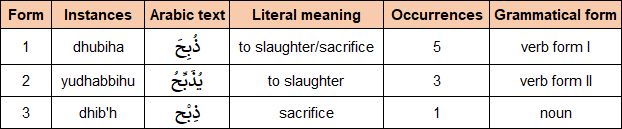
Note: The table is populated with data obtained from the Quran.corpus.com.
- Details of instances of dhubiha in verb form I meaning to slaughter or sacrifice
[2:67] Moses said to his people, “Indeed, God commands you that you slaughter a cow (inna allaha yamurukum an tadh’bahuu).” They said, “Do you take us in ridicule?” He said, “I seek refuge in God lest I would be with the ignorant ones.”
[2:71] He said, “Indeed, He (God) says, indeed, it is a cow, neither is trained to plough the land, nor to water the field, being sound having no blemish in it.” They said, “Now you have come with the truth.” So, they had slaughtered it, even they had not been near to do (fa-dhabihuuhaa wa-maa kaaduu yaf’`aluuna).
[5:3] And it has been forbidden upon you the dead animal, and the blood, and the meat of pig, and what has been sacrificed to other than God with it; and the animal which dies from strangling, and the animal which has been beaten to death, and the animal which dies fallen from a height, and the animal which dies being gored by another animal, and what the wild animal has attacked except what you have slaughtered (before its death) (wa-maa akala al-sabu`u illaa maa dhakkaytum), and what has been slaughtered on the alters (wa-maa dhabiha `alaa al-nusubi), and that you divide by the arrows of chance – that all is abomination. Today, there has given up those who have disbelieved of your religion, so you do not fear them, but you shall fear Me. Today, I have perfected your religion for you, and I have completed My blessing upon you, and I have mandated Islam as a religion for you. So, whoever has been forced (to eat) by hunger not willing for sin, then indeed, God is Forgiving, Merciful.
[27:21] That I (Solomon) will surely punish him a severe punishment or that I will surely slaughter him (la’aadh’bahannahu), unless that he can come to me with a solid reason.
[37:102] Then when he (his son) had reached the working age with him (Abraham), he said, “O my son, indeed me, I see in the dream that I am sacrificing you (innii araa al-manaami annii adh’bahuka). So look what you see?” He said, “O my father, do what you are commanded; you will find me, God willing, of the patient ones.”
- Details of instances of yadhabbihu in verb form II meaning to slaughter
[2:49] And when we had saved you from a people of Pharaoh were inflicting you with a horrible of the punishment to slaughter your sons and to let live your women (min aali fir’`awna yasuumuunakum suua al-`adhaabi yudhabbihuuna abnaa-akum wa-yastahyuuna nishaa-akum). In that there was a difficult test from your Lord.
[14:6] And when Moses said to his people, “Remember a favor of God upon you when He had saved you from a people of Pharaoh who were inflicting you with a horrible of the punishment to slaughter your sons and to let live your women (min aali fir’`awna yasuumuunakum suua al-`adhaabi yudhabbihuuna abnaa-akum wa-yastahyuuna nishaa-akum). And in that there was a difficult test from your Lord.”
[28:4] Indeed, Pharaoh had exalted himself in the earth, and had made sects into its people oppressing a group among them to slaughter their sons and to let live their women (yas’tas’`ifu taa-ifatan minhum yadhabbihu abnaa-ahum wa-yas’tah’yi). Indeed, he had been among the corruptors.
- Details of instance of dhib’h in noun form meaning sacrifice
[37:107] And we had ransomed him with a great sacrifice (wa-fadaynaahu bi-dhib’hin `azeemin).
The core messages from reviewing 9 instances of dhubiha and its derived forms found in 9 verses of 6 surahs in the Quran along with 1 instance of dhakkaytum, which is used once in the Quran are: Moses said to his people to slaughter a cow; forbidden from what the wild animal has attached except that what has been slaughtered before its death and the animal which has been slaughtered on the altars; Solomon intended to slaughter the bird, Hoopoe if he was not able to come with a good reason for his absence; Abraham saw in a dream that he was sacrificing his son; Pharaoh’s people oppressed the people of Israel slaughtering their sons but letting live their women (daughters); God had ransomed Abraham with a great sacrifice of animal instead of his son.
Instances of had’ya and its derived forms
There are 9 instances of had’ya and its derided forms in the Quran, as shown in the table below according to their grammatical forms, which are reviewed to better understand their meanings in the different contexts:

Note: The table is populated with data obtained from the Quran.corpus.com.
- Details of instances of had’ya in noun form meaning the animal offering/sacrifice
[2:196] And you shall complete the Hajj and the Umrah for God. So, if you have been prevented, then whatever he has obtained with ease of the animal for offering (fa-maa is’taysara mina al-had’yi), and you do not shave your heads until the animal for offering reaches its place of sacrifice (hattaa yab’lugha al-had’yu mahillahu). So, whoever among you has been ill or with an ailment of his head, then a ransom of fasting or charity or sacrifice. So, when you have been secure, then whoever he has taken advantage of the Umrah to the Hajj, then whatever he has obtained with ease of the animal for offering fa-maa is’taysara mina al-had’yi). But whoever cannot find (the animal), then fasting of three days during the Hajj and seven when you have returned. That is ten in all; that is for whoever of his family would not be near the Sacred Masjid. And you shall fear God, and shall know that God is severe in the retribution.
[5:2] O you who have believed, you do not violate God’s rites, nor the Sacred Month, nor the animal offering (wa-laa-al-had’ya), nor the animal garlanding, nor those who are coming to the Sacred House seeking bounty from their Lord and pleasure. And when it has been lawful for you, then you may hunt. And let not incite you the hatred of a people as they have prevented you from the Sacred Masjid that you may transgress. You shall help one another in the uprightness and the righteousness; you do not help one another in the sin and the transgression. And you shall fear God; indeed, God is severe in the retribution.
[5:95] O you who have believed, you do not kill the game (animal) while you are in Ihram. And whoever has killed it with an intention from you, then a recompense like whatever he has killed from the livestock judging with it by two just men from you that an offering is reaching the Ka`bah (minkum had’yan baaligha al-ka’bati), or an expiation by feeding needy people, or an equivalent fasting that he can perceive a consequence of his deed. God has pardoned of what has past while whoever has returned, then God will take retribution of him. And God is Almighty, Possessor of retribution.
[5:97] God has made the Ka`bah, the Sacred House is an establishment for the people, and the Sacred Month, and the animal offering (wal-had’ya), and the animal garlanding. That is that you may know that God knows whatever is in the heavens and whatever is the earth, and that God is Knower of everything.
[48:25] They were those who had disbelieved and had hindered you from the Sacred Masjid, and the animal for offering was being prevented from reaching its place of sacrifice (wal-had’ya ma`kuufan an yab’lugha mahillahu). And if not believing men and believing women you did not know them that you may trample them, then any harm would befall you from them without knowledge. That God will admit into His mercy whomever He wills. If they were apart, surely, we would have punished those who had disbelieved from them a painful punishment.
- Details of instances of hadiyyat in noun form meaning gift
[27:35] And indeed me, I (Seba) am sending a gift to them (wa-innii mur’silatun ilayhim bi-hadiyyatin); let us see what the messengers come back with.”
[27:36] Then when he had come to Solomon, he (Solomon) responded: “Do you provide me with wealth? While what God has given me is far better than what He has given you. Nay, you may rejoice with your gift (bal antum bi-hadiyyatikum taf’rahuuna).”
The core messages from reviewing 9 instances of had’ya and its derived forms found in 7 verses of 4 surahs in the Quran are: the animal offering is a ritual for the pilgrims during Hajj, which can be substituted by total 10 days of fasting; the Sacred month, the animal offering, the animal garlanding and coming to the Ka’bah seeking Lord’s bounty and pleasure are all rites of God; whoever has killed an wild animal when he is in ihram will recompense with like of it from the livestock judging with it by two just men that the animal for offering is reaching its place of sacrifice; God has made the Ka’bah is an establishment along with the Sacred month, the animal offering and the animal garlanding for the people; those who disbelieved had prevented from the Sacred Masjid, and the animal for offering reaching its place of sacrifice; when Sheba sent a gift to Solomon, then Solomon replied that God has given him more than what had been given to Her.
In brief, reviewing the instances of qarraba meaning to offer/bring near in verb form, dhubiha meaning to slaughter/sacrifice in verb form, and had’ya meaning offering/sacrifice in noun form has confirmed a ritual of animal offering, is qur’baan in noun form colloquially known as qurbaani, which comes from the root word, qariba meaning to draw nearness of God, while dhib’h is well known as dhubiha is an act to make meat lawful for the believers, and had’ya in noun form, which also means offering/sacrifice cannot be confused with hadiyyat meaning gift. Qurbaani is a practice which is done at specific location at specific occasion being only a ritual for the pilgrims who are observing Hajj, and cannot be a world-wide practice being it for the Muslims of the rest of the world. However, we may say it is or that is not in the relevant verses in the Quran because of limited knowledge will make us disbelievers in God and His guidance, but if we can reflect to the Arabic words based on the contexts not just looking for certain words in certain verses that we may interpret appropriate messages in many verses of Quran to avoid misconception and misinterpretation around us. In fact, the instances of qarraba and dhubiha indicate the spirit of the animal sacrifice from the historical event, while the instances of had’ya confirm it a ritual for the pilgrims during the Hajj. Thus, the review may help us understand that Qurbaani is not a ritual for the Muslims all over the world during the Hajj but for those who are observing Hajj centering the Ka’bah at Makkah, and Qurbaani in practice is not merely an animal sacrifice but a special ritual to bring ourselves nearness to God.
Peaceful Friday, salaam and God bless.
Tafazzal (06/05/2026).