

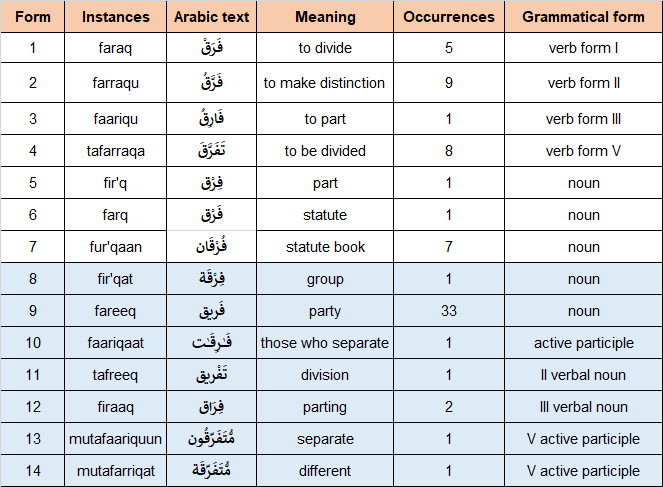
Note: The table is populated with data obtained from the Quran.corpus.com.
Out of 72 instances of faraq and its derived forms, 32 instances found in 32 verses of 18 surahs are already reviewed, while 40 instances found in 35 verses of 22 surahs are detailed out below to better understand their meaning in different contexts:
- Details of instance of fir’qat in noun form meaning group
[9:122] And it has not been for the believers that they go forth all together; so why not has gone forth a company from every group among them (min kulli fir’qatin minhum taaifatun) that they may obtain understanding in the religion and that they may warn their people when they have returned to them, so that they may be aware.
- Details instances of fareeq in noun form meaning party
[2:75] Do you then expect that they will believe for you, while there has certainly been a party of them (wa-qad kaana fareequn minhum) who hear God’s word, then they distort it after what they had understood it, while they know?
[2;85] Then you are those – you kill yourselves and evict a party of you from their homes (wa-tukh’rijuuna fareeqan minkum min diyaarihim), supporting one another against them in the sin and the transgression. And if they come to you as captives, you ransom them, while it has been forbidden for you their eviction. So, do you believe in part of the scripture and disbelieve in part? Then what is recompense for whoever does that among you, except a disgrace in the life of the world, and on a day of the Resurrection they will be returned to the most severe punishment? And God is not unaware of what you do.
[2:87] And that certainly, we had given Moses the scripture and had followed up from after him with the messengers, and we had given Jesus, son of Mary the clear proofs and had supported him with the Holy Spirit. Is it so whenever a messenger has come to you with what does not desire your egos, you had been arrogant? Then a party of you had denied (fa-fareeqan kadhabtum), and a party of you killed (wa-fareeqan taq’tuluuna).
[2:100] Is it that whenever they had made a covenant, a party of them has thrown it away (nabadhahu fareeqan minhum)? Nay, most of them do not believe.
[2:101] And when a messenger had come to them from God confirming that which was with them, a party of those who had been given the scripture, threw away God’s scripture behind their backs (nabadha fareequn mina alladheena uutuu al-kitaaba kitaaba allahi waraa-a zuhuurihim), as if they do not know.
[2:146] Those whom we have given them the scripture recognize it (Quran) like that they recognize their children, and indeed, a party of them that they conceal the truth (wa-inna minhum la’yak’tumeena al-haqqa), while they know.
[2:188] And you do not consume your properties between yourselves with the falsehood, and you may present of it to the authorities that you may consume a portion of the people’s wealth with the sin (li’takuluu fareeqan min amwaali al-naasi bil-ith’mi), while you know.
[3:23] Do you not notice towards those who have been given a part of the scripture? They are invited to a (complete) scripture of God to judge between of them, then a party of them turns away (thumma yatawallaa fareequn minhum), and they are averse ones.
[3:78] And indeed, among them surely, there is a group (wa-inna minhum la’fareeqan), they distort the tongues of them with the scripture that you (people) may think it is from the scripture, but it is not from the scripture; and they say it is from God, while it is not from God, and they say the lie about God, while they know.
[3:100] O you who have believed, if you obey a group of those who have been given the scripture (in tutee`uu fareeqan mina alladheena uutuu al-kitaaba), they will turn you back to disbelievers after your belief.
[4:77] Have you not seen to those? It has been said to them, “You shall restrain your hands and shall establish the salat prayer and shall give the zakat.” Then when the fighting has been decreed upon them, when a group of them – they fear the people as they fear God or a greater fear (idhaa fareequn minhum yakh’shawna al-naasa allahi aw ashadda khashyatan), and they said, “Our Lord, why have You decreed the fighting for us? Why have You not postponed for us to a near term?” Say, “An enjoyment of the world is little, while the Hereafter is far better for whoever has feared (God), and you will not be wronged even like a hair on a date seed.”
[5:70] That certainly, we had taken a covenant of Children of Israel, and we had sent messengers to them. Every time a messenger had come to them with what does not desire their egos; a group they had denied (fareeqan kadhabuu) and a group they killed (wa-fareeqan yaq’tuluuna).
[6:81] And how could I fear what you have associated, while you do not fear that you have associated with God what He does not send down any authority with it for you? So, which of the two parties has more right of the security (fa-ayyu al-fareeqayni ahaaqu bil-amni), if you had done to know?”
[7:30] A group He has guided (fareeqan hadaa), while a group has justified the straying on them (wa-fareeqan haqqa `alayhimu al-dalaalatu); indeed, they have taken the devils as allies other than God, and they think that they are guided ones.
[8:5] Since that your (prophet) Lord had willed to bring you out from your home with the truth, while indeed, a party of the believers were surely dislikers (wa-inna fareeqan mina al-mu’mineena la’kaarihuuna).
[9:117] That certainly, God has turned with mercy upon the prophet, and the emigrants and the helpers who have followed him at the time of the difficulty, which had done about to deviate hearts of a party of them (maa kaada yazeeghu quluubu fareeqin minhum), then He had turned with mercy upon them. Indeed, He is upon them is Kind, Merciful.
[11:24] An example of the two groups is like the blind and the deaf, and the seer and the hearer (mathalu al-fareeqayni ka’al-a`maa wa-al-asammi al-baseeri). Do they equal in analogy? Will you not then take heed?
[16:54] Then when He has removed the adversity from you, after a group of you associate partners with their Lord (idhaa fareequn minkum bi-rabbihim yush’rikuuna).
[19:73] When our clear revelations are recited to them, say those who have disbelieved to those who have believed, “Which of the two groups is better in position and best in meeting (ayyu al-fareeqayni khayrun maqaaman wa-ah’sanu nadiyyan)?”
[23:109] Indeed, it has been a group of My servants they say (innahu kaana fareequn min ibaadi-i yaquuluuna), ”Our Lord, we have believed, so forgive for us and have mercy on us, and You are best of the merciful ones.”
[24:47] And they say, “We have believed in God and in the messenger, and we have obeyed.” Then a group of them turns away after that (thumma yatawallaa fareequn minhum min ba`di dhaalika), and those are not with the believers.
[24:48] And when they have been invited to God and His messenger to judge between themselves, after a group of them is averse (idhaa fareequn minhum mu’’riduuna).
[27:45] And that certainly, we had sent to Thamud their brother Salih that you shall worship God, then after they were two disputing groups (fa’idhaa hum fareeqaani yakhtasimuuna).
[30:33] And when adversity had afflicted the people, they called their Lord being turned to Him. Then when He has made them to taste mercy from Him, after a party of them associate partners with their Lord (idhaa fareequn minhum bi-rabbihim yush’rikuuna).
[33:13] And when a party of them said (wa-idhaa qaalat fareequn minhum), “O people of Yathrib (former name of Madina), there is no stand for you; so, you shall go back.” While a group of them asked permission from the prophet saying (wa-yastadhinu fareequn minhum al-nabiya yaquluuna), “Indeed, our homes are exposed,” while they were not exposed. They do not wish except flight.
[33:26] And He had brought down those who had supported them from a people of the scripture from their fortress, and had cast the terror into their hearts – you killed a group (fareeqan taqtuluuna), and you had taken a group captive (wa-tasiruuna fareeqan).
[34:20] And that certainly, Satan had found truth of his assumption about them that they had followed him, except a group of the believers (illaa fareeqan mina al-mu’mineena).
[42:7] And thus that we have revealed to you (prophet) an Arabic Quran that you may warn mother of the cities (Makkah) and whoever is around of it, and you may warn of a day of the Gathering, there is no doubt in it. A party will be in the Paradise (fareequn fee al-jannati), and a party will be in the blazing Fire (wa-fareequn fee al-sa`iiri).
- Details of instance of faariqaat in active participle meaning those who separate
[77:4] And those (angels) who record good and evil (fa-al-faariqaati farqan).
- Details of instance of tafreeq in verbal noun meaning division
[9:107] And those who have taken masjid for having harm and disbelief, and division among the believers (wa-tafreeqan bayna al-mu’mineena), and as a station for whoever has warred against God and His messenger before; while surely, they swear: “We have not intended except the good,” and God bears witness that indeed, they are surely liars.
- Details of instances of firaaq in verbal noun meaning parting
[18:78] He said, “This is parting between of me and between of you (haadhaa firaaqu bayni-i wabaynika). I will inform you of an interpretation on what you were not able to have patience over it.”
[75:28] And he (a disbeliever at the time of death) has believed that it is the parting (wa-zanna annahu al-firaaqu).
- Details of instance of mutafarriquun in active participle meaning separate
[12:39] “O my (Joseph) two companions of the prison, are separate lords better (a-arbaabun mutafarriquuna khayrun) or God, the One, the Supreme?”
- Details of instance of mutafarriqat in active participle meaning different
[12:67] And he (Jacob) said, “O my sons, you do not enter from one gate, and shall enter from different gates (wa-ud’khuluu min ab’waabin mutafarriqatin). And I cannot help you anything against God, the judgment is not except with God. Upon Him I put trust and upon Him should put trust those who put trust.”
The core messages from reviewing 40 instances of faraq and its derived forms found in 35 verses of 22 surahs in the Quran are God wants the believers to become knowledgeable about their religion having up to date teaching of it; He sent many messengers to the people of Israel, while they rejected some of them and killed some of them; a party of those who were given the scripture, threw away God’s scripture behind their backs when a messenger had come to them from God confirming what was with them; the people of the scripture who recognize the Quran as they recognize their children but a party of them conceal the truth; those who are given incomplete scripture are invited to a complete scripture, a party of them turns away, while a party of them who distort their tongues with the scripture and say it is from God but it is not from Him; the Satan had found his truth for those who have followed him being a great number except the believers being a small number while the majority have justified the straying on them; an Arabic Quran given to a prophet who had warned a people of the mother city, Makkah and a people around it about a day of the Gathering while a party will enter the Paradise and a party will go to the Hell; He has cited an example with the blind and the deaf, and the seer and the hearer to take heed; He has warned the believers that if they listen to a party who are given scripture will turn them back to disbelievers after their belief being it challenging to stay in the path of God as they are surrounded by the Satan and his allies.
However, God has let us know that there has been a party of His servants they say, ”Our Lord, we have believed, so forgive for us and have mercy on us, and You are best of the merciful ones.”, and we may also wish to be blessed by Him to be in this party, even the number is very small or may be only one as cited in a city in the Quran as example to which three messengers were sent but there was only one believer who was told to enter the Paradise at the time of his death He said “I wish my people knew (36:26) of that my Lord has forgiven for me, and has made me of the honorable ones.” (36:27).
Peaceful Friday, salaam and God bless.
Tafazzal (04/10/2026).