

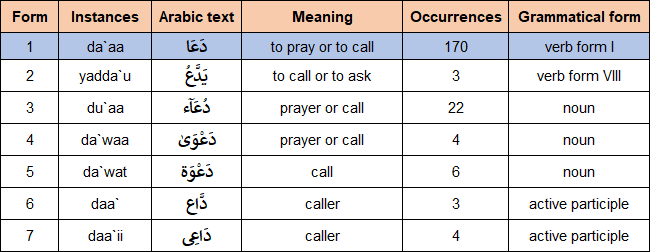
Note: The table is populated with data obtained from the Quran.corpus.com., and `a represents the Arabic letter, ayn not to confuse with aleef which represents a in the document.
Out of 212 instances of da`aa and its derived forms, 53 instances of da`aa found in 46 verses of 9 surahs in the Quran are detailed out below to better understand their meaning in different contexts, while an Arabic word may have different meanings in different contexts:
- Details of instances of da`aa in verb form I meaning to pray, call or invite
[2:23] And if you have been in doubt of what we have sent down to our servant, then you shall produce of a surah like of it, and shall call upon your witnesses other than God (wa-`id’`uu shuhadaa-akum min duuni allahi), if you have been truthful ones.
[2:61] And when you said, “O Moses, we cannot endure on one kind of food, so pray for us to your Lord to produce for us from what the earth grows (fa-ud’`u lanaa rabbaka yukh’rij lanaa mimma tunbitu al-ardi) of its beans, and its cucumbers, and its garlic, and its lentils, and its onions.” He said, “Would you exchange that which is inferior to that which is better? Go down to Egypt, then indeed, there is for you what you have asked for.” And there had been struck on them the humiliation and the misery, and they had brought upon themselves wrath of God. That was of that they had done to disbelieve in God’s signs and kill the prophets without the justice. That was of that they had disobeyed, and they had done to transgress.
[2:68] They said, “Ask for us to your Lord to make clear for us what is it (ud’`u lanaa rabbaka yubayyin lanaa maa hiya)?” He said, “Indeed, He says, Indeed, it is a cow, neither old, nor young – a middle aged between that.” So, you shall do what you are commanded.”
[2:69] They said, “Ask for us to your Lord to make clear for us what is its color (ud’`u lanaa rabbaka yubayyin lanaa maa lawnuhaa)?.” He said, “Indeed, He says, indeed, it is a yellow cow bright in its color is pleasing to those who see.”
[2:70] They said, “Ask for us to your Lord to make clear for us what is it (ud’`u lanaa rabbaka yubayyin lanaa maa hiya)? Indeed, all cows look alike to us, and indeed we, if God wills, will surely be the guided ones.”
[2:186] And when anyone of My servants has asked you about Me, then indeed, I am near. I respond to a call of the caller when you call Me (idhaa da’`aani). So, they shall respond to Me and shall believe in Me so that they may be guided.
Note: This verse is a continuation of the last part of the verse, 2:185: ‘and that you may glorify God through which He has guided you, and that you may appreciate’, which refers to the first part of the verse: ‘Ramadan which is a month has been sent down in it the Quran as guidance for mankind and clear proofs of the guidance and the statute book’, and the middle part addresses the Ramadan fasting.
[2:221] And you do not marry the idolatresses unless they believe. And a believing slave woman is better than an idolatress, even if she has pleased you. And you do not get to marriage to the idolaters, unless they believe. and that a believing slave man is better than an idolater, even if he has pleased you. Those – they invite to the Fire (ulaaika yad’`uuna ilaa al-naari), while God invites to the Paradise (wa-allahu yad’`uu ilaa al-jannati) and the forgiveness by His permission. And He makes clear His revelations for the people so that they may take heed.
[2:260] And when Abraham said, “My Lord, show me how You give life to the dead.” He said, “Do you not believe?” He said, “Yes, but to satisfy my heart.” He said, “So, take four of the birds, then incline them towards you, then place a piece from them on each hill, then call them (thumma ud’`uhunna), they will come to you in hurry, and you shall know that God is Almighty, Wise.”
[2:282] O you who have believed, when you have contracted one another of any debt for a fixed period, then you shall write down it and a scribe shall write down between of you with the justice. And a scribe should not refuse that he writes like that God has taught him. So he shall write down and the one on whom is the right shall dictate. And he shall fear God, his Lord and will not diminish anything from it. Then if the one on him is the right of a limited knowledge, or weak, or he is not able to dictate, then his guardian shall dictate with the justice, and shall call for two witnesses from your men, then if there are not two men, then one man and two women you agree of the witnesses that she errs – one of two, then one of two will remind the other. And the witnesses should not refuse when that they have been called upon (them) (idhaa an du`uu). And do not be weary that you write down it whether lesser or greater for its term. That is more just with God and more straight for the evidence and nearer that you do not have doubt except that a transaction be present, you carry out among yourselves, then it has not been any sin upon you that you do not write down. And you shall have witness when you have made an commercial transaction. A scribe should not be harmed, nor a witness, and if you do, then indeed, it is a sinful conduct for you, and you shall fear God. And God teaches you and God is Knower of everything.
[3:23] Did you not notice towards those who have been given a part of the scripture? They are invited to a (complete) scripture of God to judge between themselves (yud’`awana ilaa kitaabi allahi li’yah’kuma baynahum), then a party of them turns away, and they are averse ones.
[3:38] When Zakariya had prayed to his Lord (hunaalika da’`aa zakariya rabbahu), he said: “My Lord, grant for me a pure offspring from Yourself; indeed, You are Hearer of the prayer.”
[3:61] Then whoever has argued with you (prophet) about it after what has come to you of the knowledge, then say, “Come, we call our sons and your sons, and our women and your women, and ourselves and yourselves (ta`aalaw nad’`u ab’naa-anaa wa-ab’naa-akum wa-nisaa-anaa wa-nisaa-kum wa-anfusanaa wa-anfusakum), then we make a humble prayer that we invoke a curse of God upon the liars.”
[3:104] And that there may be a community from you to invite to the good (wal’takun minkum ummatun yad’`uuna ilaa al-khay’ri), and to enjoin with the good, and to forbid from the evil. And those – they are the successful ones.
[3:153] When you were running uphill, and you were not looking towards anyone, while the messenger were calling you from behind of you (wal-rasuulu yad’`uukum fee ukh’raakum). So, He had given you distress over distress that you do not grieve over what had escaped you, and what had not befallen you. And God is Cognizant of what you do.
[4:117] They do not call other than Him except female gods (in yad’`uuna min duunihi illaa inaathan), and they do not call except a rebellious Satan (wa-in yad’`uuna illaa shay’taanan mareedan).
[6:40] Say, “Have you seen if there has come to you a punishment of God or there has come to you the Hour, do you call other than God (a-ghayra allahi tad’`uuna) if you have been the truthful?”
[6:41] Nay, you call Him alone (bal iyyaahu tad’`uuna) that He removes what you call to Him (fa-yakshifu maa tad’`uuna ilayhi) if He has willed, and you forget what you associate.
[6:52] And you (prophet) do not send away those who call their Lord in the morning and evening seeking His pleasure (alladheena tad’`uuna rabbahum bil-ghadati wal-`ashiyi yureeduuna wajhahu). You are not responsible for their reckoning, nor are they responsible for your reckoning. So, if you send them away, then you will be with the wrongdoers.
[6:56] Say, “Indeed me, I (prophet) have been forbidden that I (prophet) worship those whom you call other than God (alladheena tad’`uuna min duuni allahi).” Say, “I (prophet) do not follow your desires; certainly, I (prophet) would have gone astray then, and I would not be with the guided ones.”
[6:63] Say, “Who saves you from darkness of the land or the sea?” You call Him being humble and in secret (tad’`uunahu tadarru`an wa-khuf’yatan): “That if He saves us from this, that we will surely be with the grateful ones.”
[6:71] Say, “Shall we call other than God what cannot benefit us (a-nad’`uu min duuni allahi maa laa-yanfa`uunaa), nor can it harm us, and we are turned back on our heels after God has guided us?” Like the one whom the Satan has enticed in the earth, is confused, he has companions who call him to the guidance (lahu ashaabun yad’`uunahu ilaa al-hudaa): “Come to us!” Say, “Indeed, God’s guidance is the true guidance, and we have been commanded that we submit to Lord of the worlds.
[6:108] And you (believers) do not insult those whom they call other than God (wa-laa-tasubbuu alladheena yad’`uuna min duuni allahi), lest they may insult God in enmity having no knowledge. Thus that we have made fair seeming their deed for every community. Then to their Lord is their return that He will inform them of what they had done to accomplish.
[7:29] Say, “My Lord has commanded with the justice, while you shall stand yourselves at every masjid and shall call Him being sincere to Him in the religion (wa-id’`uuhu mukh’liseena lahu al-deena); as that He has created you that you will return.”
[7:37] So, who is more wicked than whoever has invented lie about God, or has denied in His revelations? To those their portion reaches them in accordance with the record, until when there has come our messengers (angels) to put them in death they said, “Where is whom you had done to call other than God (ayna maa kuntum tad’`uuna min duuni allahi)?” They said, “They have gone away from us.” and they have borne witness against themselves that they had been disbelievers.
[7:55] You shall call your Lord being humble and in secret (id’`uu rabbakum tadarru`an wa-khuf’yatan); indeed, He does not love the transgressors.
[7:56] And you do not spread corruption in the earth after its reformation; and you shall call Him in fear and hope (wa-id’`uuhu khawfun wa-tama`an). Indeed, God’s mercy is near for the good-doers.
[7:134] And whenever the punishment had fallen upon them, they said, “O Moses, call for us to your Lord of what He has promised to you (id’`u lanaa rabbaka bimaa `ahida `indaka). That if you had removed the punishment from us, that we will surely believe for you and that we will surely send Children of Israel with you.”
[7:180] And to God belongs the most graceful names; so, you shall call Him with them (fa-id’`uuhu bihaa) and shall disregard those who deviate from (calling) His names. They will be recompensed what they have done to achieve.
[7:189] He is the One who has created you from one soul and has made its mate from it that he can live with her. Then when he covers her, she has carried a light load that she has passed with it. Then when it has grown heavier, they both call God, their Lord (da`awaa allaha rabbahumaa): “That if You have given us a righteous one, that we will surely be among the thankful ones.”
[7:193] And if you call them to the guidance (wa-in tad’`uuhum ilaa al-hudaa), they will not follow you. It is same for you whether you have called them (sawaaon `alaykum a-da`awtumuuhum), or you are silent ones.
[7:194] Indeed, those whom you call other than God are servants like of you (inna alladheena tad’`uuna min duuni allahi `ibaadun amthaalukum). So, you shall call them that they shall respond to you (fa-id’`uuhum fal-yastajeebuu lakum), if you have been truthful ones.
[7:195] Are there feet for them to walk with them or hands for them to hold with them, or eyes for them to see with them, or ears for them to hear with them? Say, “Call your partners (id’`uu shurakaa-akum), then scheme against me that do not give me respite.”
[7:197] And those whom you call other than Him (wa-alladheena tad’`uuna min duunihi), they cannot do any help to them nor can they help themselves.”
[7:198] And if you call them to the guidance, they do not hear (wa-in tad’`uuhum ilaa al-hudaa laa-yasma`uu). And you see them looking at you, while they do not see.
[8:24] O you who have believed, you shall respond to God and to the messenger when He has called you to that He gives life to you (idhaa da`aakum limaa yuh’yeekum). And you shall know that God comes between the person and his heart, and that to Him you will be gathered.
[10:12] When the adversity had touched the human being, he would have called us on his side, or sitting, or standing (da`aanaa li-janbihi aw qaa`idan aw qaaiman). Then when we have removed his adversity from him, he has passed on as if he does not call us for an adversity had touched him (ka-an lam yad’`unaa ilaa durrin massahu). Thus that there has been made fair-seeming for the extravagant what they have done to accomplish.
[10:22] He is the One who makes you to travel in the land, and the sea until when they have been in the ships, and they have sailed with a good wind and have rejoiced with it; there has come to it a violent wind and has come to them the waves from every place and they have assumed that they have been surrounded by them. They have called God being sincere to Him in the religion (da`awuu allaha mukh’liseena lahu al-deena): “That if You have saved us from this, that we will surely be with the thankful ones.”
[10:25] And God calls to an abode of the peace (wa-allahu yad`uu ilaa daari al-salaami), and guides whomever He wills to a straight path.
[10:38] Or do they say, “He has invented it?” Say, “Then bring of a surah like of it, and call whomever you might have been other than God (wa-id’`uu mani is’tata`tum min duuni allahi), if you have been truthful ones.”
[10:66] No doubt; indeed, to God belongs whoever is in the heavens and whoever is in the earth. And you do not follow those who call partners other than God (wa-maa yattabi`u alladheena yad’`uuna min duuni allahi shurakaa-a). They do not follow except the conjecture, nor do they do except guess.
[10:106] And you (prophet) do not call other than God, which cannot benefit you (wa-laa-tad’`u min duuni allahi maa laa-yanfa`uka), nor can it harm you. So, if you have done so, then indeed, you will be then with the wrongdoers.
[11:13] Or they may say, “He has fabricated it.” Say, “Then bring of ten fabricated surahs like of it, and call whoever you might have been other than God (wa-id’`uu mani is’tata`tum min duuni allahi), if you have been truthful.”
[11:62] They said, “O Saleh, you have been one to whom there was a great expectation among us before this. Do you forbid us that we worship what our forefathers would worship? And indeed, we are surely in doubt being suspicious from what you call us to it (wa-innaa lafee shakkin mimmaa tad’`uuna ilayhi mureebin).”
[11:101] And we have not wronged them but they had wronged themselves. So, their gods had not helped them in anything, whom they call other than God (allatee yad’`uuna min duuni allahi) when there had come your Lord’s command, while they had not increased them other than loss.
[12:33] He (Yusuf) said, “My Lord, the prison is better to me than what they invite me to it (rabbi al-sij’nu ahabbu ilayya mimmaa yad’`uunanii ilayhi). And unless You turn away their plot from me I would incline to them and I would be among the ignorant ones.”
[12:108] Say (prophet), “This is my path: I invite to God with enlightenment (ad’`uu ilaa allahi `alaa baseeratin) – I and whoever has followed me. And glory be to God and I am not with the idolaters.”
The core messages from reviewing 53 instances of da`aa found in 46 verses of 9 surahs in the Quran are: there is a challenge for those who have doubt about the Quran sent down to His servant to produce a surah like it calling upon their witnesses; the people of Moses asked him to pray to his Lord that the earth grows for them what they can eat and to make clear for them the cow that they can sacrifice; God responds to a call of his servants when they call Him; marrying of idolaters and idolatresses invites us to the Hell; God taught Abraham to convince his heart about the resurrection upon returning the killed birds to him when He had called them; those who were given a part of the scripture are invited to a scripture of God to judge between themselves; Zakariya prayed to his Lord for them a pure offspring; when there is dispute about any knowledge given in our guidance we may call together in an humble prayer invoking a curse of God upon the liars; we may be a community to invite to enjoin with the good and to forbid from the evil; when a punishment comes from God we do not call other than Him; we should not call other than God what cannot benefit nor harm us; the angels of death at the time of death ask those who have called other than God, “where are those whom you had called?”, while they will witness against themselves that they were disbelievers; there are those who are called to the guidance, but they do not follow it; the prophet was forbidden to worship those whom (the female gods) his own people belonging to his tribe used to call them, not to be among the misguided ones; those who have believed shall respond to God and to the messenger when He has called you that He gives life to you and you will gathered to Him; those whom are called other than God, they cannot help anyone, even they cannot help themselves; those whom we may call other than God are also servants of Him like ourselves; those who had wronged themselves have been destroyed in the past is a warning for the subsequent generations; prophet had been told to say that he and whoever has followed him would invite to God with enlightenment being it his path, while glory be to God that he is not among the idolaters.
This review may help us understand that the salat prayer is different from the prayer reflecting to the Arabic words, sallaa and da`aa, but the source of words to call our Lord is the Quran to be responded by Him (2:186), which is a guidance for mankind, proofs of the guidance and the statute book (2:185). However, our call will be a call other than God if we invent lie about God and deny in His revelations, and at the time of our death we will witness against ourselves that we were disbelievers, and if we die as disbelievers there is a painful punishment for us and there are no helpers for us (3:91).
Peaceful Friday, salaam and God bless. Tafazzal (05/08/2026).