

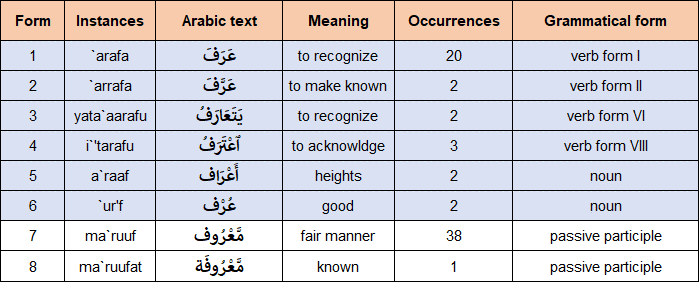
Note: The above table is populated with data obtained from the corpus.quran.com.
Here are reviewed 31 instances to better understand their meanings in different contexts:
- Details of instances of `arafa in verb form I meaning to recognize
[2:89] And when there came to them a scripture from God, confirming that which was with them —while they used to pray for victory before over those who disbelieved — then when there came to them what they recognized (fa-lammaa jaa-ahum maa `arafuu), they disbelieved in it. So, God’s curse is on the disbelievers.
[2:146] Those to whom we have given the scripture recognize it just as they recognize their children (alladheena aataynaahumu al-kitaaba ya`rifuunahu kamaa ya`rifuuna abnaa-ahum), and indeed, a party of them surely conceal the truth while they know.
[2:273] For the poor who have been restricted in the path of God, they are not able to travel in the land. The ignorant one thinks them rich because of their restraint; you recognize them by their sign (ta`rifuhum bi-seemaahum), they do not ask people with importunity. And whatever of good you spend, then indeed, God is Knower of it.
[5:83] And when they listened to what was sent down to the messenger, you see their eyes overflowing with tears because of what they recognized of the truth (mimmaa `arafuu mina al-haqqi). They say, “Our Lord , we believe, so record us with the witnesses.”
[6:20] Those to whom we have given the scripture recognize it just as they recognize their children (ya`rifuunahu kamaa ya`rifuuna abnaa-ahum). Those who lost their souls, they do not believe.
[7:46] And between them is a barrier, and on the Heights are people who recognize all by their mark (ya`rifuuna kullan bi-seemaahum). And they called out to the companions of Paradise, “Peace be upon you!” They had not entered it, while they are hoping.
[7:48] And the companions of the Heights called out to people whom they recognized by their mark, saying (ya`rifuunahum bi-seemaahum qaaluu), “Your gathering did not profit you, nor did that which you used to be arrogant about.”
[12:58] And Yusuf’s brothers came and entered in upon him. So, he recognized them (fa-`arafahum), but they were ignorant of him.
[12:62] And he said to his assistants, “Put their goods into their saddlebags so that they may recognize them (la`allahum ya`rifuunahaa) when they return to their people, in the hope that they will come back.”
[16:83] They recognize the favor of God (ya`rifuuna ni`mata allahi), yet they deny it; and most of them are ungrateful disbelievers.
[22:72] And when our clear revelations are recited to them, you can recognize the denial on the faces of those who disbelieve (ta`rifu fee wujuuhi alladheena kafaruu al-munkara). They almost attack those who recite our revelations to them. Say, “Should I then inform you of something worse than that? The Fire! God has promised it to those who disbelieve; and it has proven to be a miserable destination.”
[23:69] Or is it that they do not recognize their messenger (am lam ya`rifuu rasuulahum), so they are rejectors of him?
[27:93] And say, “Praise be to God; He will show you His signs so that you will recognize them (sa-yureekum aayaatihi fa-ta`rifuunahaa). And your Lord is not unaware of what you do.”
[33:59] O Prophet, say to your wives, and your daughters, and the wives of the believers to draw their garments over themselves. That is more appropriate so that they will be recognized and not be harmed (dhaalika adnaa yu`raf’na fa-laa-yu’dhayna). And God has ever been Forgiving, Merciful.
[47:30] And if we willed, we could have shown them to you, so you would surely recognize them by their marks (fa-la-`araftahum bi-seemaahum); and you will surely recognize them by the tone of the speech (wa-la-ta`rifannaahum fee lahni al-qawli). And God knows your deeds.
[55:41] The guilty will be recognized by their marks (yu’`rafu al-muj’rimuuna bi-seemaahum); then they will be seized by the forelocks and the feet.
[83:24] You will recognize in their faces the radiance of the bliss (ta`rifu fee wujuuhihim nad’rata al-ni’`eemi).
- Details of instances of `arrafa in verb form II meaning to make known
[47:6] And He will admit them into the Paradise, which He has made known to them (`arrafahaa lahum).
[66:3] The prophet had confided a statement to one of his wives; then when she divulged it, and God made it known to him, he made known a part of it (`arrafa ba`dahu) and avoided a part. Then when he informed her of it, she said, “Who informed you of this?” He said, “The Knower, the Cognizant has informed me.”
- Details of instances of yata`aarrafu in verb form VI meaning to recognize
[10:45] And the Day He will gather them, as if they had not remained except for an hour of the day, recognizing between themselves (yata`aarafuuna baynahum). Certainly, those who denied the meeting with God have lost, and they had not been guided ones.
[49:13] O mankind, indeed, we have created you from a male and a female, and we have made you nations and tribes, that you may recognize one another (lita`aarafuu). Indeed, the most noble of you with God is the most righteous of you. Indeed, God is Knower, Aware.
- Details of instances of i`’tarafu in verb form VIII meaning to acknowledge
[9:102] And others who have confessed their sins (wa-aakaruuna i`’tarafuu bi-dhunuubihim); they have mixed a righteous deed and another that is evil. It has been hoped that God will turn to them; indeed, God is Forgiving, Merciful.
[40:11] They said, “Our Lord, You have given us death twice and You have given us life twice, so we have confessed our sins (fa-`’tarafnaa bi-dhunuubinaa); then is there any way out?”
[67:11] Then they have confessed of their sins (fa-i`’tarafuu bi-dhanbihim), so far are to the dwellers of the Blazing Fire.
- Details of instances of a`raaf in noun form meaning heights
[7:46] And between them is a barrier, and on the Heights are people (wa-`alaa al-a`raafi rijaalan) who recognize all by their mark. And they called out to the companions of Paradise, “Peace be upon you!” They had not entered it, while they are hoping.
[7:48] And the companions of the Heights called out to people whom they recognized by their mark; they said, (ya`rifuunahum bi-seemaahum qaaluu) “Your gathering did not profit you, nor did that which you used to be arrogant about.”
- Details of instances of `ur’f in noun form meaning good
[7:199] You (the prophet) shall accept forgiveness, and shall enjoin the good (wa-mur bil-`ur’fi), and shall turn away from the ignorant.
[77:1] By those sent one after another (wa-mur’salaati `ur’fan),
Reviewed 31 instances of `arafa and its derived forms in 28 verses of 20 surahs in the Quran: God’s curse on those who disbelieved when they recognized what came from Him, while they should recognize it as just they recognize their children; their eyes overflow with tears when they have recognized the truth that came from God; people on the Heights will recognize all by their mark – they have called out to the companions of the Paradise, “Peace be upon you”, and they called out to the other people, “Your gathering did not profit you”; those who denied the meeting with God have lost their souls not being guided ones on the Day He will gather them; the most noble with God are those from male and female who are the most righteous; those who have confessed their sins, while they have mixed righteous deeds with evil ones will hope God will turn to them; those who have been given death and life twice will expect a way out confessing their sins; even those who have confessed their sins are to the dwellers of the Blazing Fire; the ungrateful disbelievers deny the favor of God, even they recognize it; those who deny God’s revelations – their denial can be recognized on their faces; the rejectors do not recognize their messenger.
Thus, it would be better for us if we could recognize our messenger and the favor of God. If the truth came to us from Him, we would be the most righteous so as to be the most noble with Him, being admitted into the Paradise which He has made known to its dwellers.
Peaceful Friday, salaam and God bless.
Tafazzal (9/4/26)